US News
Simple AC changes can cut summer cooling bills by 10%
Households can cut heating and cooling costs by as much as 10% a year by turning the thermostat back 7 to 10 degrees for eight hours a day, the U.S. Department of Energy says, and the same logic applies in summer when you set the system higher and raise it again when no one is home. DOE says heating and cooling typically account for 43% of a home’s electricity bill, while space cooling alone averages 6% of household energy use nationwide.
Start with the thermostat
The most effective move is usually to let the house warm up more than you think it should. Set a programmable thermostat as high as comfortable in summer and increase the setpoint when you are away from home, because every degree matters when the compressor is the biggest load in the house. For many homes, the practical benchmark is not “as cold as possible” but “cool enough to stay comfortable without overcooling empty rooms.”
For cooling, ENERGY STAR’s certification framework includes presets of at least 78°F in the morning and evening, at least 85°F during the day, and at least 82°F at night. Those numbers are not magic for every household, especially in humid climates or in homes with different occupancy patterns, but they show how much room there is between comfortable living and wasteful overcooling.
Smart thermostats can help make those adjustments automatic. Certified smart thermostats are independently verified using actual field data, and ENERGY STAR says homes with high heating and cooling bills or homes that sit unoccupied much of the day can save about $100 a year with one. A thermostat that reliably raises the temperature when the house is empty tends to save more than one that depends on someone remembering to change it manually.
Use fans as a comfort tool, not a room-cooling tool
Ceiling fans are useful because they reduce how hot a room feels on your skin, not because they lower the room temperature itself. Using a ceiling fan lets you raise the thermostat by about 4°F without reducing comfort, DOE says, which can translate into real savings when that higher setpoint keeps the air conditioner from running as often.
That distinction matters because fans only help when people are in the room. Turn fans off when you leave, since they cool people, not rooms. Running a fan in an empty space adds to the electric bill without reducing the workload on the air conditioner in any meaningful way.
Know which habits save money and which mostly feel frugal
The biggest summer savings come from managing setpoints and occupancy. If the house is empty during work hours, vacations, or school runs, a higher thermostat setting does more than a bundle of minor habits ever will. That is why the DOE advice focuses on when to raise the temperature, not just how low to keep it in the evening.
A lot of common “frugal” habits have smaller effects than people expect. Closing vents, layering on extra blankets in an already overcooled home, or obsessing over tiny temperature changes can feel thrifty without materially changing the bill. The measurable gains come from reducing the number of hours the system must remove heat and humidity, especially during the hottest part of the day.
If you do not have central air, the numbers still favor efficient equipment
Households without central cooling can still save with the right room unit. Certified room air conditioners use about 10% less energy and, on average, cost less than $70 a year to run, ENERGY STAR says. That makes efficiency labels especially relevant for apartments, additions, and smaller homes where a single window or room unit may carry much of the seasonal load.
For these setups, the same principle holds: avoid making the machine work harder than it needs to. A well-sized, certified room unit paired with a higher setpoint often delivers more savings than an oversized model running at a colder setting.
Maintenance prevents waste before it shows up on the bill
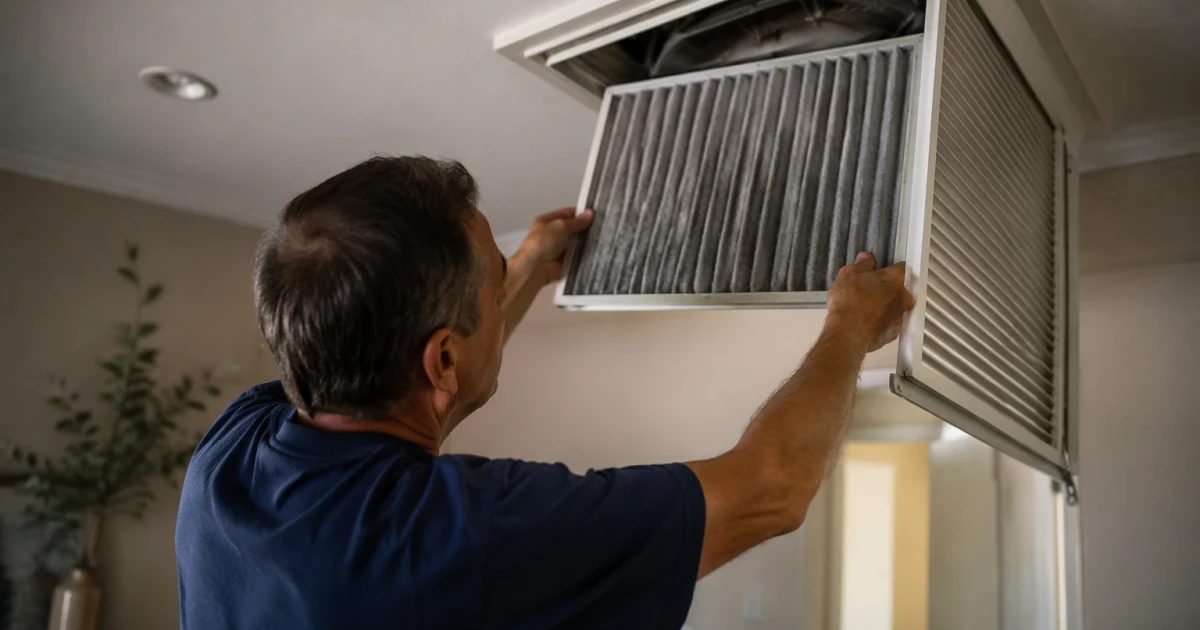
Basic upkeep does not always feel like a savings strategy, but it is one of the few that directly prevents wasted electricity. A dirty air filter slows airflow and makes the system work harder, DOE says, which means more energy use for the same level of comfort. Checking filters every month is a simple way to keep the system from losing efficiency over the course of a long cooling season.
Annual service also matters because small problems tend to become expensive ones in hot weather. A system that is serviced once a year is less likely to struggle with airflow restrictions, refrigerant issues, or other hidden inefficiencies that force longer run times.
Heat pumps need a different touch
Heat pumps deserve special handling because their behavior changes with the season. Programmable thermostats are generally not recommended for heat pumps in heating mode, DOE says, but in cooling mode a heat pump acts like an air conditioner and still saves energy when you raise the thermostat. That means the summer advice still applies, but the winter guidance is not interchangeable.
Comfort, humidity, and the type of system in the house all affect how far you can push the setpoint. In a dry climate, 78°F may feel entirely reasonable; in a humid home, the same number may feel heavier and may require more fine-tuning.
Sources
- [1]cbsnews.com
- [2]energy.gov
- [3]energystar.gov