Business
Six million U.S. business owners face a retirement transition wave

A retirement wave is moving through America’s small-business backbone, and the central question is whether those companies will change hands cleanly or quietly disappear. McKinsey says about 6 million small and medium-size businesses will face ownership transitions by 2035, with more than 1 million viable for sale and as much as $5 trillion in enterprise value on the line.
The scale matters because small businesses make up 99% of all U.S. companies, employ more than 60 million workers and generate 35% of business revenue. McKinsey estimates that effective transitions could preserve up to 12 million jobs, while failed ones could strip communities of locally rooted firms, tax revenue and a path to economic mobility. The risk is not evenly spread. Rural areas are especially exposed, and McKinsey says that under current patterns only 28% of transferring value would accrue to women and Black and Latino individuals combined. Closing those gaps could unlock as much as $3 trillion in new household wealth and preserve about $250 billion in annual local spending power.

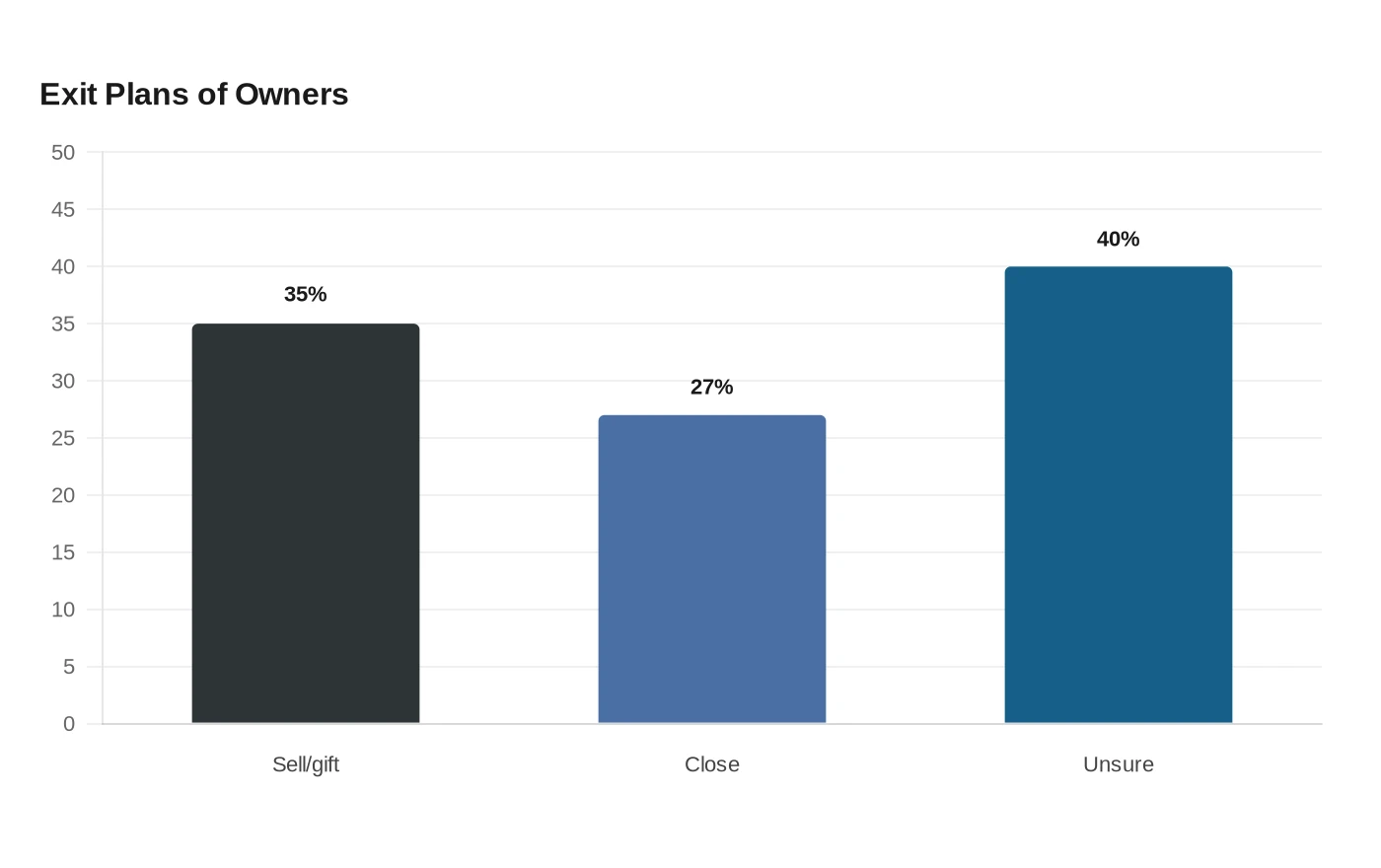
The succession crunch is already visible in ownership data. Gallup reported in March 2025 that 52.3% of U.S. employer-businesses are owned by people 55 and older, about 3 million of nearly 6 million private-sector employer firms. Among employer-business owners nearing retirement, 74% said they plan to sell or transfer the business. But the picture is far murkier for firms without employees: just 35% plan to transfer ownership through a sale or gift, 27% expect to close, and 40% are unsure. Over the next five years, 14% of all owners said they would sell, go public or transfer ownership, while 8% said they would close.

Employee ownership is emerging as one practical answer. The U.S. Department of Labor launched its Employee Ownership Initiative in 2023 under SECURE 2.0, saying it is designed to expand workplace participation, improve workers’ financial security and support succession planning. The department points to three main structures: employee stock ownership plans, worker cooperatives and employee ownership trusts. The National Center for Employee Ownership says about 6,411 companies use ESOPs, involving 10.9 million employees, or about 8% of the private-sector workforce.

The policy stakes are larger than a single exit strategy. Harvard Business School’s Institute for Business in Global Society says only about 20% to 30% of businesses that go to market actually sell, and only about a third of family-owned businesses reach a second generation. Tony Guidotti of Harvard’s Ownership Project has warned that the country needs a strategy for the silver tsunami, and Rhode Island lieutenant governor Sabina Matos has warned that mass closures would leave storefronts empty and neighborhoods hollowed out. As the great ownership transfer accelerates, worker buyouts are being measured not as a niche idea, but as a test of whether local wealth can stay local.
Sources
- [1]bbc.com
- [2]mckinsey.com
- [3]news.gallup.com
- [4]dol.gov
- [5]esop.org
- [6]hbs.edu