Business
SpaceX IPO exposes SPV investors to fees, delays and fraud risk
SpaceX’s march toward a public listing is shining a harsh light on a corner of finance that many retail investors barely see: the SPV layer between them and the stock they think they are buying. The promise is simple access to one of the world’s most sought-after private companies; the reality can include extra fees, delayed cash-outs and a legal claim that may be several steps removed from SpaceX shares themselves.
Why the wrapper matters
The key issue is ownership. Many retail-access products and private-share funds do not hold SpaceX stock directly; they use special purpose vehicles or similar fund structures that sit between investors and the underlying shares. That means the economics of the position, including what an investor ultimately receives, may not be fully clear until after IPO lock-ups expire and any underlying shares can actually be sold.
That distinction matters because “access” is not the same as direct share ownership. In some cases, investors are buying exposure through a listed fund or other wrapper while the actual stock sits inside an SPV. At least one ETF sponsor has said its SpaceX exposure is held through an SPV inside a registered ETF structure, with no direct accredited-investor requirement, which broadens access but also makes the ownership chain more opaque.
Lock-ups delay the truth
The biggest timing risk is the lock-up period. Reuters reported on June 1, 2026 that SpaceX reserved 5% of shares in its planned IPO for certain employees and people selected by executive officers, and that those reserved shares were exempted from post-IPO lock-up restrictions through a directed share program. Any reserved shares not taken in that program would go to the general public.
That creates a two-tier market from the start. Some holders can potentially sell sooner, while others remain trapped behind lock-up restrictions, and that split can distort price discovery. For SPV investors, the result is especially frustrating: they may not learn the true economic value of their position until the underlying shares can be sold and the fund can unwind its structure.
The February 2, 2026 filing for Liberty Street Advisors’ Private Shares Fund made the risk explicit, warning that private companies often impose lock-ups that can prevent sales after an IPO and expose fund investors to price declines before sale is allowed. In other words, the market can move against the SPV investor long before the SPV itself can convert paper gains into cash.

Existing products show how concentrated the bet has become
The scale of this trade is already large. Liberty Street Advisors said on April 21, 2026 that its Private Shares Fund had surpassed $1.1 billion in assets, and that SpaceX was its largest position at 19.3% of net assets. A separate February filing said SpaceX accounted for 13.64% of portfolio value as of December 31, 2025, underscoring how quickly late-stage private-market funds have built exposure to the company.
ERShares has taken a similar approach with its XOVR ETF. On May 21, 2026, the firm said it increased SpaceX exposure to about 23% of fund assets with a $35 million purchase, using what it described as an effective 0/0 SPV structure inside a registered ETF wrapper. The sponsor also said the structure was designed to meet regulatory requirements, which shows how product design is being used to bring private-company exposure into public-market packaging.
That packaging can be attractive because it lowers the barrier to entry. But it can also blur the line between direct access and indirect economic exposure. The more layers there are, the harder it becomes for a retail buyer to know how much of the payment is for the underlying stock, how much is tied to the wrapper, and how much could disappear in fees or execution costs.
Fees are only part of the cost
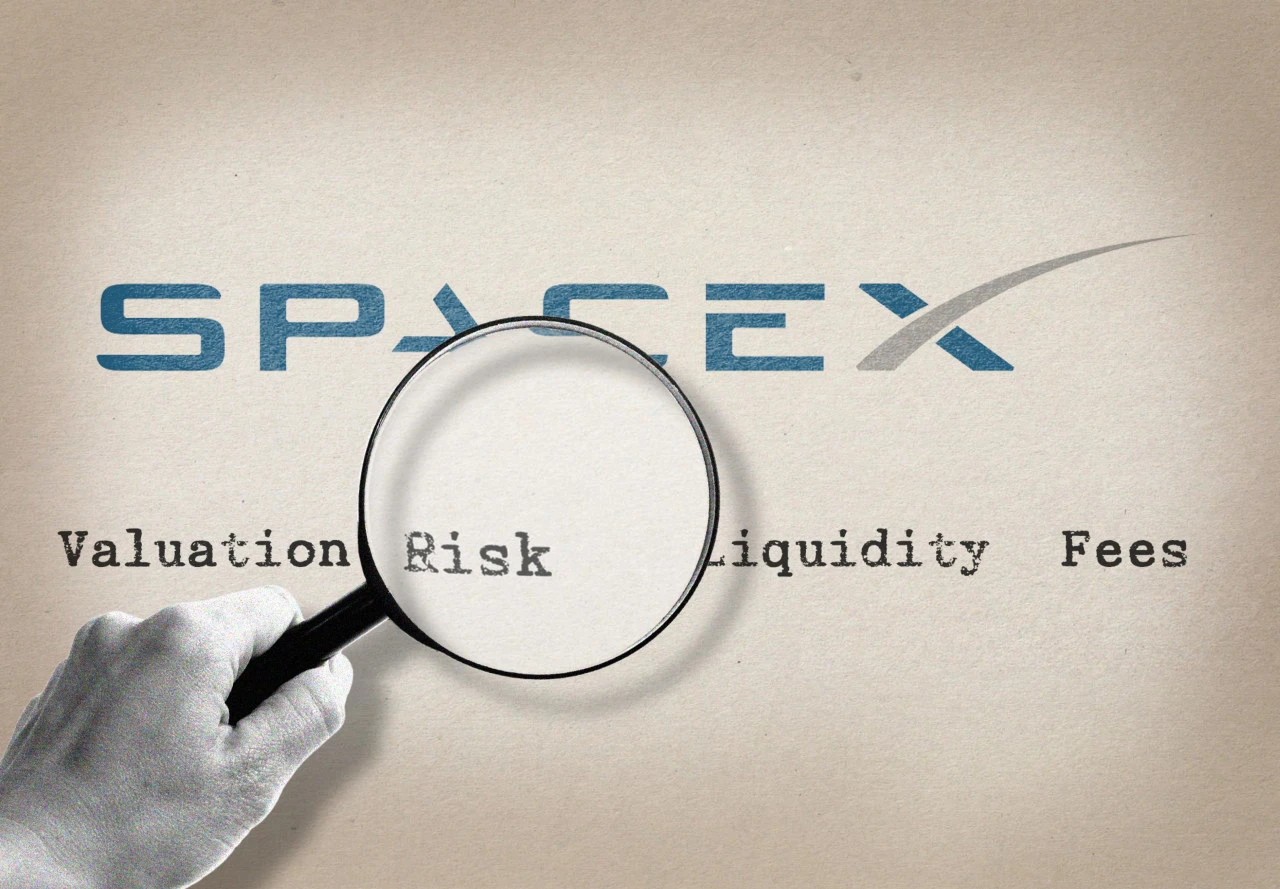
The money investors pay is not just about the headline expense ratio. SPV-based products can carry management fees, performance fees, administrative charges and trading costs, and those layers may be embedded in the structure rather than obvious on the first page of a product pitch. Even when an ETF sponsor describes an “effective 0/0 SPV structure,” investors still need to understand how the fund actually acquires, values and exits the underlying position.
This matters more when the asset is as large and as illiquid as SpaceX. The tighter the supply of shares and the longer the holding period, the more likely the economics of the structure will depend on timing rather than just business fundamentals. If the market price surges before the SPV can sell, the wrapper may still capture value, but if the market weakens during the lock-up, the investor absorbs the downside first and asks questions later.
Valuation is the real prize, and the real trap
SpaceX’s valuation makes the appetite for these products easy to understand. A February 2026 filing said the company had reportedly been valued at about $800 billion after a year-end tender offer, while also citing reports that a late-2026 IPO could potentially value SpaceX at $1.5 trillion. Those are extraordinary numbers, and they explain why investors are willing to tolerate complexity in exchange for a shot at the upside.
But the same valuation excitement can produce a false sense of certainty. A product may be marketed as SpaceX exposure, yet the exact value of that exposure can remain unstable until the IPO process is complete, lock-ups expire and the shares can be sold into the public market. For retail investors, the key question is not simply whether SpaceX goes public, but whether the structure they bought into can turn that public event into cash on terms they actually understand.
What to check before buying an SPV-linked product
The most important questions are practical:
• Does the product own SpaceX directly, or through an SPV or other intermediary?
• What fees are charged at the fund level, at the SPV level, and at exit?
• When can the underlying shares actually be sold?
• Who gets access to reserved shares, and are those shares subject to different lock-up rules?
• What happens if the IPO is delayed, repriced or oversubscribed?
These details can determine whether an investor is buying genuine economic participation or merely a delayed promise of it. In a market where a 5% reserved-share program can create one set of rules for insiders and another for everyone else, transparency is not a cosmetic issue. It is the difference between owning the upside on paper and understanding when, and how, it can actually be realized.
The bottom line
SpaceX’s eventual public debut is likely to intensify demand for private-company exposure, not reduce it. That makes the SPV layer more important, not less, because it is where fees, delays, liquidity constraints and potential fraud risks can accumulate before a retail investor ever sees a share certificate or a cash payout. The IPO may be the headline event, but the real story is whether ordinary investors know what they bought before the public market finally sets the price.
Sources
- [1]techcrunch.com
- [2]money.usnews.com
- [3]markets.ft.com