Technology
Springer erases Max Planck essays, historians call move anachronistic
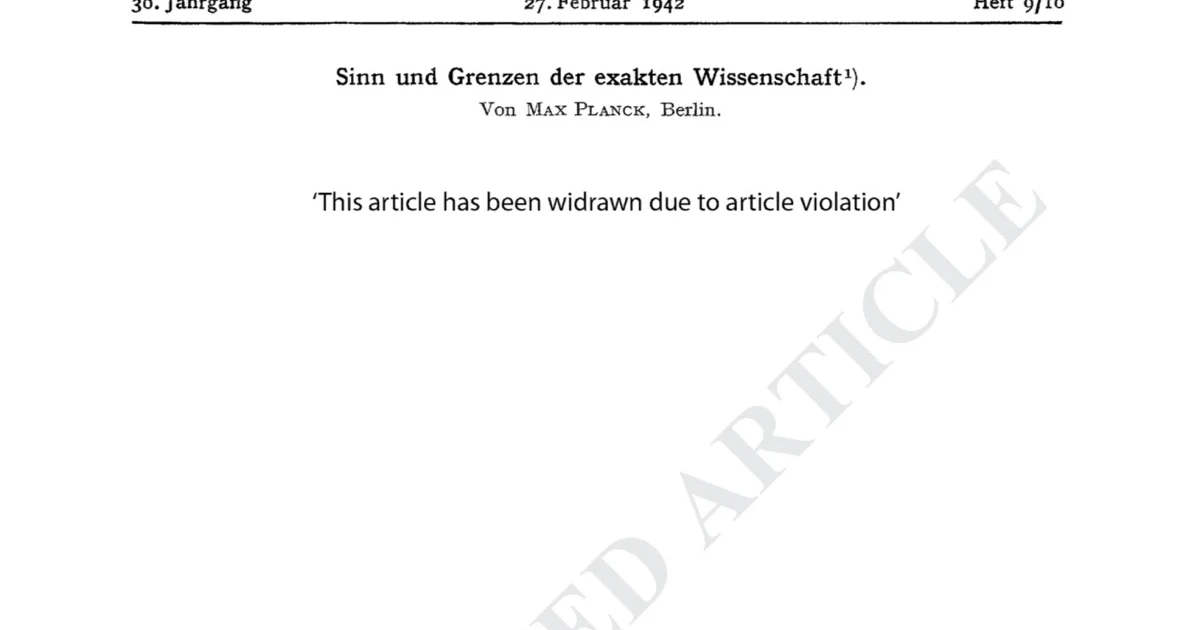
Springer Nature’s platform has blanked out two Max Planck essays, labeling the 1940 and 1942 papers in Naturwissenschaften, now The Science of Nature, as “RETRACTED ARTICLE” while leaving empty PDFs in place of the text. The 1940 file now opens to pages 778 to 779 with no content, and the 1942 file is empty across pages 125 to 133.
That treatment is unusual for the journal. Springer’s normal practice is to keep retracted papers online with a retraction notice attached, not to remove the article text itself. In this case, the online record has been scrubbed even though the papers were not withdrawn for fabricated data or experimental misconduct.
The case surfaced when historians Yves Gingras of Université du Québec à Montréal and Mahdi Khelfaoui of Université du Québec à Trois-Rivières noticed Planck on Retraction Watch’s list of Nobel Prize winners with retractions. Their preprint argues that the withdrawals grew out of contemporary digitization and copyright-management procedures being applied to historical material, not from any scientific fraud. The authors also say the original papers remain available through the nonprofit Internet Archive.
Planck died in 1947, and the historians note that his works are in the public domain in many countries. That makes modern copyright logic a poor fit for papers that were published decades before current digital publishing rules existed. The authors argue that applying ideas such as duplicate publication and self-plagiarism to early-20th-century philosophical essays distorts the historical record instead of clarifying it.
The stakes are larger than a single physicist’s archive. Planck, who founded quantum theory in 1900 and won the 1918 Nobel Prize in Physics, was one of the most prominent scientists of his era. Historian John Heilbron described him as an “upright man,” which helps explain why the retraction labels struck historians as so implausible. The episode has become a case study in how commercial digital infrastructures can reshape access to scientific history, especially when modern editorial systems are imposed on politically and intellectually fraught eras without regard for archival context.