Science
Studies Affirm Einstein’s Gravity Holds Across the Cosmos
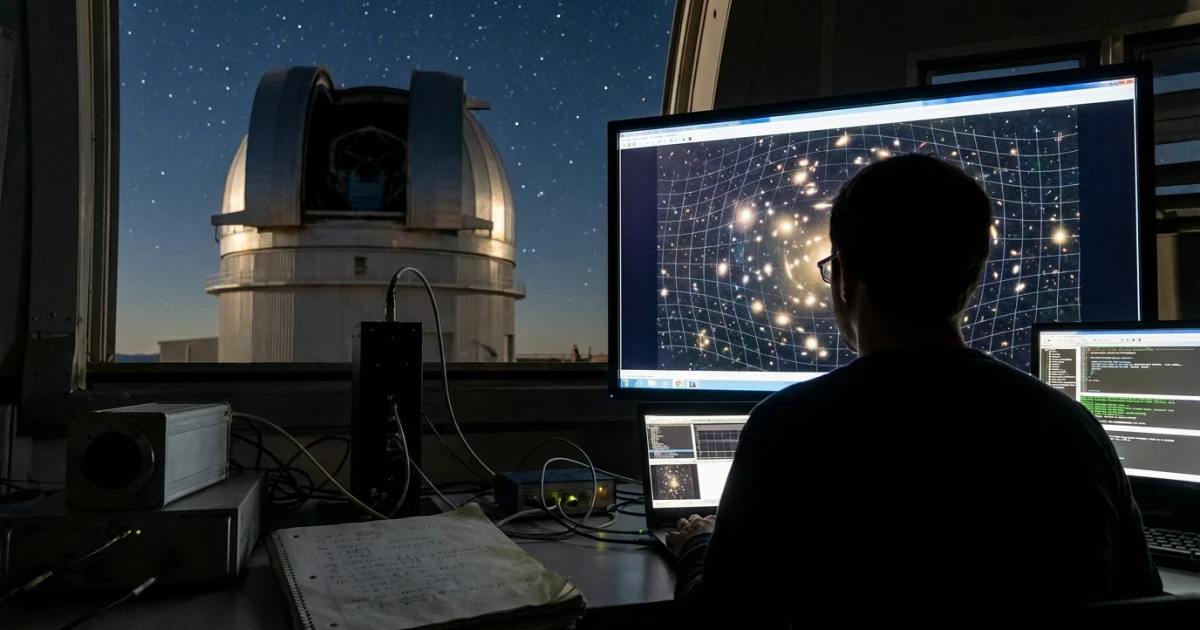
New research using galaxy clusters has provided some of the clearest evidence yet that the laws of gravity, as described by Newton and Einstein, hold true even at the vastest distances in the universe. The findings, highlighted by Phys.org, reinforce the standard cosmological model and the existence of dark matter, deepening our understanding of how gravity shapes the cosmos.
Testing Gravity on Cosmic Scales
For over a century, Einstein’s theory of general relativity has been the foundation for understanding gravity, from the motion of planets to the expansion of the universe. However, astronomers and physicists have long debated whether these laws apply universally—especially on the largest scales, where unseen phenomena like dark matter and dark energy dominate.
By studying the behavior of galaxy clusters, which are the universe’s most massive gravitationally bound structures, scientists have been able to put Einstein’s predictions to the test. These clusters act as natural laboratories, letting researchers probe gravity’s behavior over distances millions of light-years across.
Findings Reinforce the Standard Model
According to the Phys.org report, teams at institutions including USC Dornsife conducted detailed analyses of the mass and motion within galaxy clusters. Their measurements show that gravity’s pull—whether calculated using Newton’s law of universal gravitation or Einstein’s general relativity—matches the observed behavior of galaxies and hot gas within these clusters.
- Data from X-ray and optical surveys of galaxy clusters support the presence of unseen mass, consistent with dark matter.
- The observed gravitational effects align with predictions from Einstein’s equations, even at scales far larger than our solar system.
- Alternative theories of gravity, which attempt to explain cosmic phenomena without dark matter, receive less support from these results.
Why This Matters for Cosmology
These findings are significant for several reasons. First, they bolster the “standard model of cosmology,” which holds that the universe is composed primarily of dark energy, dark matter, and ordinary matter, all interacting through gravity as described by Einstein’s theory.
Second, the results challenge proponents of alternative gravity theories—such as Modified Newtonian Dynamics (MOND) or tensor-vector-scalar gravity—which try to do away with dark matter by tweaking the laws of gravity. The new evidence makes it harder for these alternatives to explain the observed motions and distributions of galaxies within clusters.
Looking Ahead: Future Probes of Gravity
While the latest studies provide strong support for Einstein and Newton, physicists continue to seek cracks in the theory that might point to new physics. Upcoming projects like the Legacy Survey of Space and Time at the Vera C. Rubin Observatory will survey billions of galaxies, offering even more stringent tests of gravity on the largest scales. Data from the Planck mission and other observatories also provide crucial benchmarks for cosmological parameters and gravitational effects.
Conclusion
For now, as recent research affirms, the universe appears to still play by the rules set out by Newton and Einstein—a finding that strengthens the foundation of modern cosmology and highlights the enduring power of classical physics, even in the most extreme environments known to science.