Science
Study finds biomedical preprints often hold up after peer review

Biomedical preprints are not the free-floating drafts many skeptics imagine. In a new analysis of 72,644 bioRxiv preprint-publication pairs, the central claim stayed intact in most abstracts after peer review, while major reversals were uncommon. The finding sharpens the debate over how much trust early research deserves, especially in biomedicine, where speed can matter as much as polish.
What the 72,644-study analysis measured
The study behind the headline tracked every bioRxiv preprint posted between 2018 and 2025 that could be matched by DOI to a later peer-reviewed paper. To make the comparison consistent, the authors used a large language model, Claude Sonnet 4.6, to extract one primary claim and two secondary claims from each abstract, then classified changes as unchanged, minor, or major, along with shifts in how cautious the language became. On a validation sample, the model’s agreement with two independent domain experts was in the same range as the experts’ agreement with one another, with Cohen’s kappa between 0.63 and 0.66.
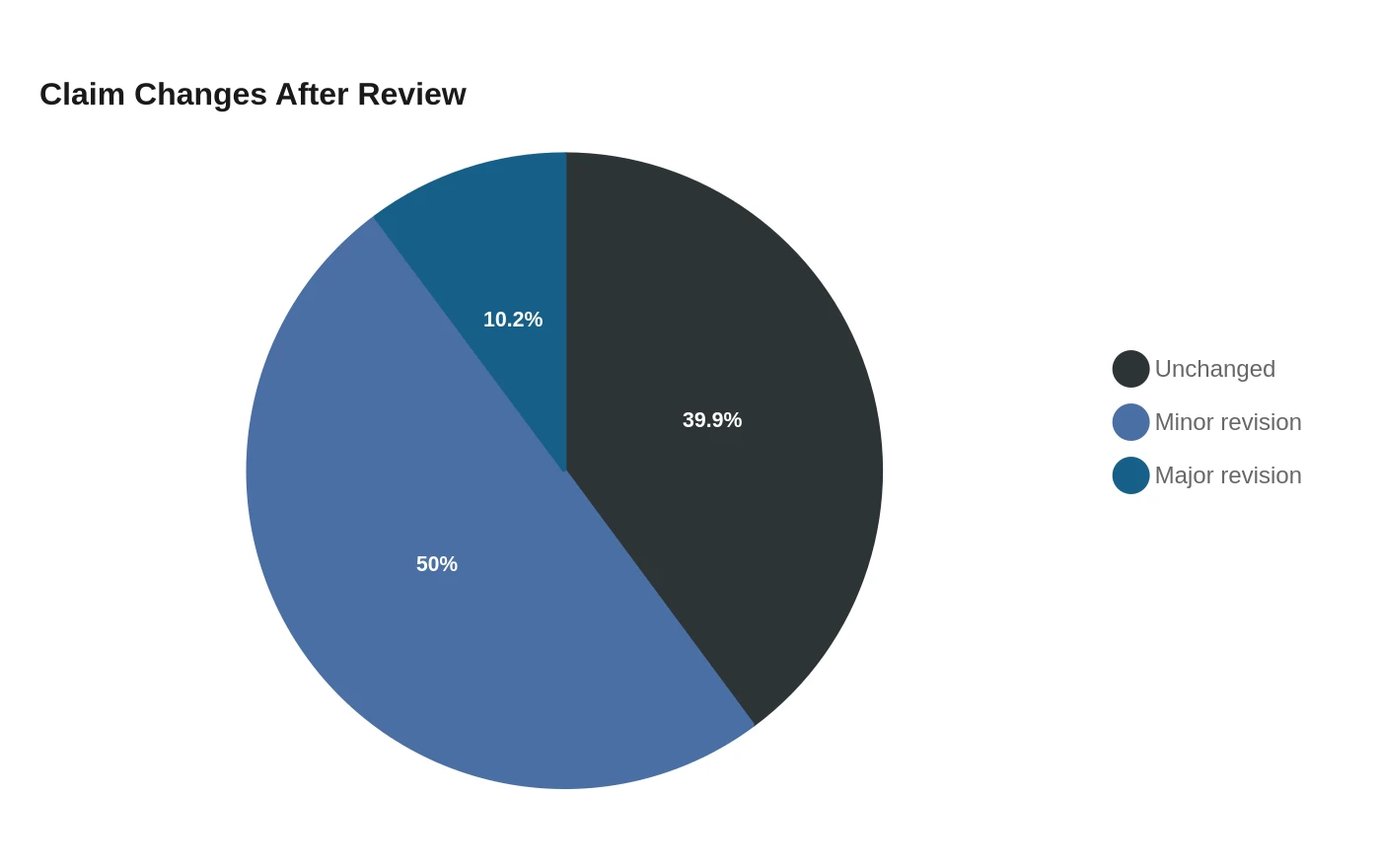
That method matters because the paper is not arguing that every preprint is flawless. It is making a narrower claim: when a biomedical study moves from preprint to journal article, the main message usually survives. In the dataset, the primary claim was unchanged in 39.9% of abstracts, minorly revised in 50.0%, and substantially revised in only 10.2%. In other words, the most common outcome was adjustment at the edges, not a rewrite of the scientific bottom line.
What tends to hold up, and what shifts
The strongest signal in the analysis is stability at the level that matters most to readers trying to understand where evidence is heading. The abstract’s primary claim usually stayed the same, and when language changed, it was more often a matter of caution than contradiction. Hedging shifts were uncommon, but when they happened they ran in one direction more often than the other, with 8.4% of claims becoming more cautious and 4.2% becoming more confident.

That does not mean peer review does nothing. The analysis found that major revisions were more frequent after longer review cycles, 14.1% in the slowest tertile of review time versus 7.0% in the fastest. The share of major revisions also fell over time, from 17.0% in 2019 to 5.7% in 2024. The picture is of a system that often edits the framing, tempers the tone, and occasionally pushes a paper farther from its preprint version, but rarely flips the central conclusion.
For readers, the practical lesson is straightforward: the headline result of a biomedical preprint often deserves attention, but the language around it still deserves inspection. A claim that survives peer review is not automatically correct in every detail, and a preprint that later gets refined is not automatically unreliable. The meaningful divide is not preprint versus published paper, but whether the study design, sample size, and interpretation can support the claim being made.
Why preprints have become central to biomedical reporting
The urgency around this issue comes from how deeply preprints are now embedded in biomedical communication. The bioRxiv paper notes that preprints disseminate a large share of biomedical research before peer review, and that bioRxiv alone has hosted more than a quarter of a million manuscripts, roughly two-thirds of which eventually appear in peer-reviewed journals. During the COVID-19 pandemic, preprint servers became a primary channel for biological and clinical findings, making the question of reliability impossible to ignore.
That scale changes the institution’s role in the research system. Preprints can establish priority, speed up discussion, and let scientists circulate findings while funding cycles, outbreaks, and competitive fields are still moving. Nature’s explainer frames the issue as workflow, not rebellion: early sharing can be useful for speed, transparency, and open discussion even before the full journal process is complete.
Where skepticism still belongs
The new analysis supports confidence in the broad arc of many biomedical preprints, but it does not erase the need for judgment. The Nature piece points readers back to the basic checks that still matter: methodology, sample size, and the limits of any single study. That caution is especially important when a claim is early, unusually consequential, or based on a narrow dataset that could shift with stronger evidence.
A useful way to read a preprint is to separate the main claim from the strength of the support around it. If the conclusion is modest and the later published version keeps the same message, the preprint may already be a reliable guide to where the evidence is heading. If the claim is sweeping, the methods are thin, or the review process produces major revisions, the reader should slow down and treat the result as provisional. The study’s own pattern, with only 10.2% of primary claims substantially revised, shows that caution and usefulness are not opposites; they are part of the same reading discipline.
What this means for trust in science publishing
The broader trust test is not whether preprints are perfect. It is whether the scientific system can share results early without sacrificing rigor. By finding that the main claims of most biomedical abstracts remain intact after peer review, the analysis argues that preprints are not disposable drafts at the margins of science, but a serious part of the research record that often gives an accurate first look at the evidence. It also offers one more institutional clue: over the same period, biomedical papers that were never posted as preprints were retracted at roughly twice the rate of those that were.
That is the measure that matters now. Peer review still refines, filters, and sometimes corrects. But the evidence in this 72,644-study analysis suggests that biomedical preprints are often closer to the final scientific judgment than their reputation allows, and that the real challenge is learning how to read them with both speed and discipline.
Sources
- [1]nature.com