World
Study finds most people naturally walk counterclockwise, reason unclear
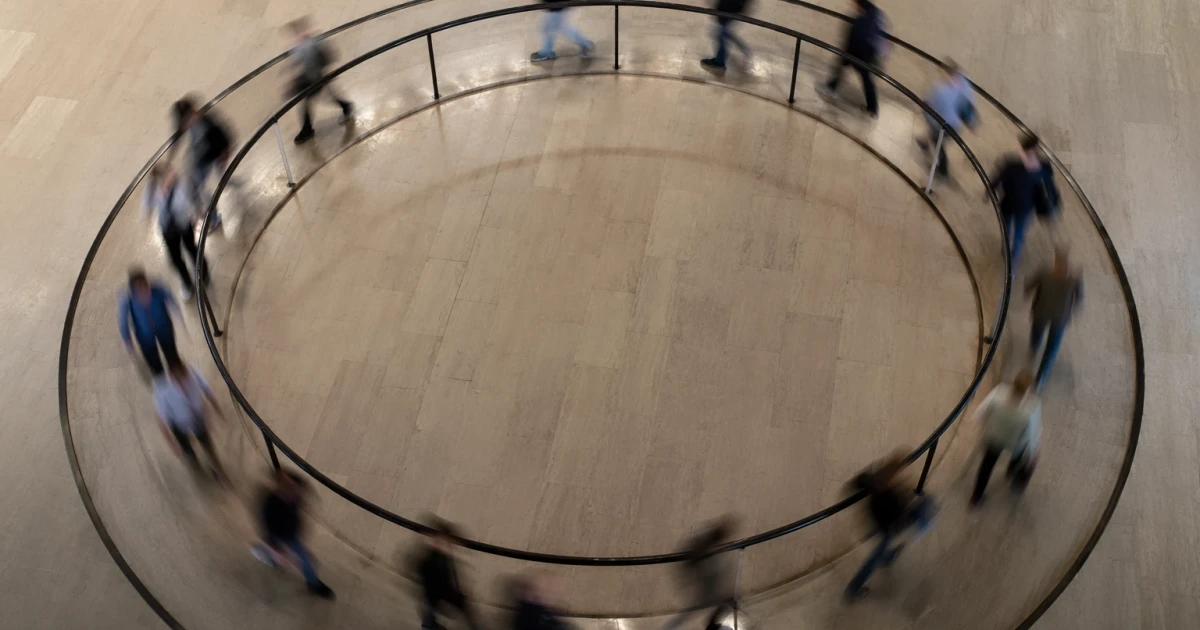
Most people do not just wander through a crowd. They tend to veer the same way, and a new study found that way is counterclockwise. Across five experiments in Spain and Japan, the bias appeared in 32 of 33 trials, suggesting that the tendency is rooted in individual movement rather than only in the way crowds behave together.
The work, published in Nature Communications on June 10, 2026, came out of pedestrian research led by Claudio Feliciani, Iñaki Echeverría Huarte and Antoine Tordeux. The original experiments were done at the University of Navarra in Spain, then repeated with a team at the University of Tokyo. What began as COVID-19-era work on pedestrian movement and social distancing ended up exposing a pattern the researchers had not set out to test.
The surprise was not simply that people turned left. It was that they did so in open settings, in more constrained spaces and even in virtual reality tests. The pattern held across different environments and survived comparisons between Spain and Japan, which weakened the idea that local custom alone was driving the effect. Culture and gender made little difference, while age did matter a little: younger participants showed the counterclockwise tendency more strongly.
The researchers still do not know what causes the bias. That uncertainty is central to the story. Human movement often looks automatic until scientists isolate a pattern that repeats across settings, countries and experimental designs. In this case, the question is whether the preference reflects how the brain organizes space, how people orient their bodies, or some smaller motor bias that only becomes visible when enough people are watched closely.
The finding also fits into a broader line of crowd research. A 2024 Nature study of the San Fermín festival in Pamplona, Spain, showed that dense crowds could self-organize into macroscopic chiral oscillations, coordinating the orbital motion of hundreds of people. That work also compared its crowd behavior with the 2010 Love Parade disaster in Duisburg, Germany. The new study pushes the idea one step earlier, arguing that the crowd pattern may begin with a directional bias inside individual walkers.
University publicity around the research said the result could matter for understanding the brain, and for design, engineering and architecture. That makes the odd little habit of veering left more than a curiosity. It may be a clue to how people move through shared space, and how built environments quietly shape the flow of bodies through them.
Sources
- [1]news.google.com
- [2]nature.com
- [3]u-tokyo.ac.jp
- [4]eurekalert.org
- [5]phys.org