Science
Study Finds Uranus and Neptune May Be Rock-Rich
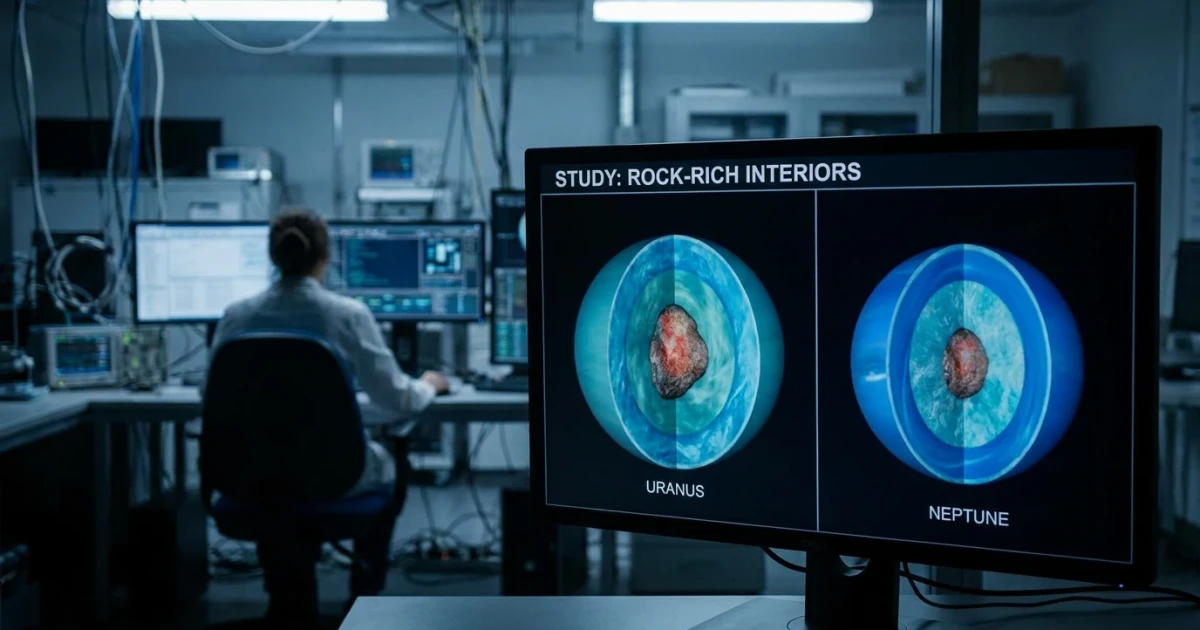
A recent scientific study has prompted fresh debate about the interiors of Uranus and Neptune, indicating they may be far rockier than previously believed. This new analysis challenges decades-old assumptions about the so-called ice giants, raising important questions about planetary formation and the future of deep space exploration.
Reevaluating the Ice Giants
For years, Uranus and Neptune have been classified as ice giants, believed to have interiors dominated by water, ammonia, and methane ice, mixed with a relatively small proportion of rock. This classification was primarily informed by indirect observations and modeling, notably from the Voyager mission data and subsequent ground-based studies.
The recent study, reported by Space, leverages improved computational methods to simulate the behavior of water–rock mixtures under extreme pressures inside these planets. The findings suggest that rock may constitute a significantly larger fraction of their interiors than previously assumed, potentially reshaping our understanding of their formation.
Key Findings and Scientific Implications
- Rock-rich interiors: The new research indicates that Uranus and Neptune could contain far more rock than earlier models predicted, possibly making their cores much larger and denser.
- Planetary formation: These results challenge traditional formation theories, which assumed a gradual build-up of ices after rock cores were established. A rock-heavy interior could suggest a more violent or rapid formation process.
- Magnetic fields: The composition of the interior directly affects the generation of magnetic fields. Both Uranus and Neptune have unusual magnetic fields compared to other planets, and a rock-dominated interior may help explain these anomalies.
- Atmospheric characteristics: The study's findings may also shed new light on why the two planets have differing atmospheric dynamics and heat signatures despite similar sizes and compositions.
These insights are supported by detailed measurements from NASA's Uranus overview and Neptune overview, which document their physical characteristics and provide the baseline for ongoing research.
Why Does This Matter?
Understanding the true nature of Uranus and Neptune is vital for several reasons:
- It helps scientists refine models of planetary interiors, applicable not just to our solar system but also to exoplanets in distant star systems.
- It informs future mission planning, as more accurate interior models can guide instrument design and target selection for potential probes or orbiters.
- It provides critical context for interpreting planetary magnetic fields, weather, and atmospheric phenomena.
Ongoing Exploration and Future Questions
Despite these advances, much remains unknown. The last major flybys of Uranus and Neptune occurred in the 1980s with Voyager 2, and scientists have called for new missions to directly sample their atmospheres and probe their interiors. The European Space Agency and NASA continue to prioritize these planets in their exploration agendas, recognizing their potential to reveal fundamental truths about planetary science.
As computational methods improve and data from new telescopes and future missions become available, researchers hope to confirm or refine these latest findings. In the meantime, the study offers a compelling reappraisal of what lies beneath the clouds of Uranus and Neptune, providing fresh impetus for scientific inquiry and exploration.
Conclusion
In light of this new research, Uranus and Neptune may need to be reclassified—not just as ice giants, but as planets with interiors dominated by rock. This shift in understanding could have ripple effects throughout astronomy and planetary science, offering new clues about how planets form and evolve both within our solar system and beyond.