US News
Supreme Court Considers Limits on Birthright Citizenship
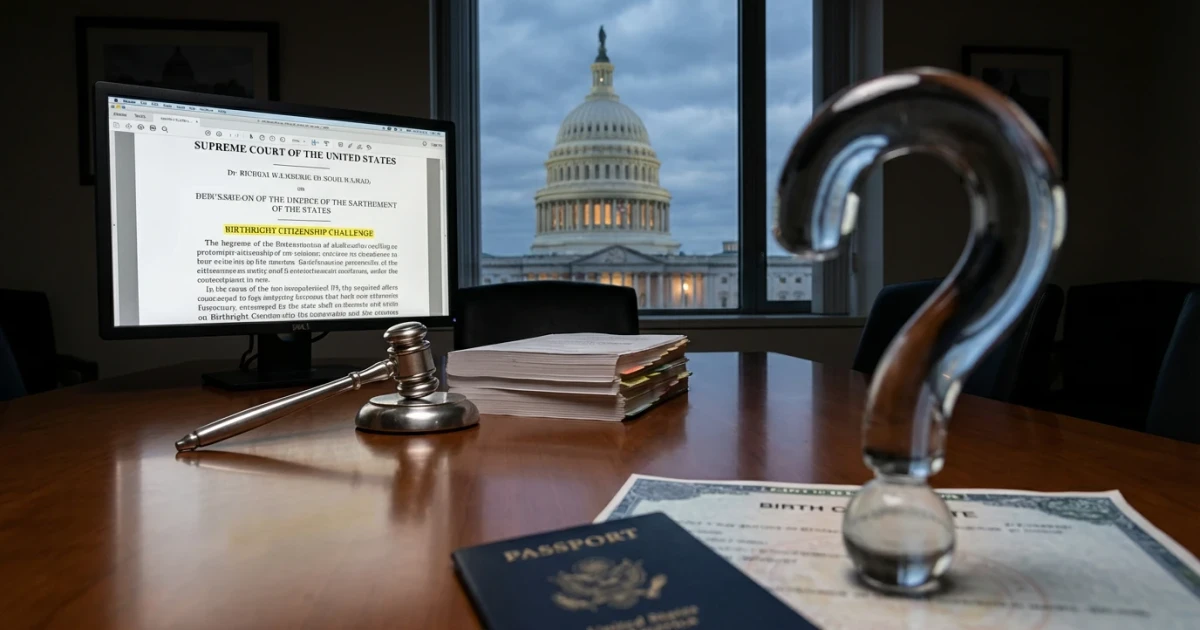
Washington, D.C. — The Supreme Court is examining a high-profile case that could significantly alter the longstanding principle of birthright citizenship in the United States, raising concerns about widespread legal uncertainty for children born on U.S. soil. This challenge, which has drawn national attention, questions whether the Constitution guarantees automatic citizenship to all individuals born in the country, regardless of their parents’ immigration status.
The Legal Foundation of Birthright Citizenship
The concept of birthright citizenship is rooted in the 14th Amendment, ratified in 1868, which states: “All persons born or naturalized in the United States, and subject to the jurisdiction thereof, are citizens of the United States.” This principle was upheld in the landmark United States v. Wong Kim Ark decision in 1898, in which the Supreme Court affirmed that the children of foreign nationals born in the U.S. were entitled to citizenship.
Current Challenge and Historical Precedent
The current case, as reported by CNN, is driven by efforts to reinterpret or overturn this precedent. Former President Donald Trump and his allies have referenced an earlier Supreme Court decision from 1884—Elk v. Wilkins—in which the Court denied citizenship to a Native American born on U.S. soil, arguing he was not “subject to the jurisdiction” of the United States in the way the 14th Amendment required. Trump’s legal team contends that this phrase could exclude children born to undocumented immigrants from automatic citizenship.
However, the 1898 Wong Kim Ark decision directly addressed the issue, holding that almost everyone born in the U.S.—with narrow exceptions such as children of foreign diplomats—qualifies for citizenship. Legal scholars and organizations note that this interpretation has been the standard for more than a century.
Potential Consequences and Concerns
CNN reports that legal experts warn of the “chaos” that could ensue if the Supreme Court revises or overturns birthright citizenship. Millions of children born in the U.S. could face challenges in proving their citizenship status, creating uncertainty in access to passports, education, and government services.
- According to CDC data, more than 3.6 million babies were born in the United States in 2021 alone.
- Analysis from the Migration Policy Institute estimates that hundreds of thousands of these children have at least one parent who is an unauthorized immigrant.
- Official USCIS statistics indicate that over 800,000 people became naturalized U.S. citizens in 2022, highlighting the scale of citizenship determination in America.
Arguments and Broader Implications
Supporters of restricting birthright citizenship argue the current policy incentivizes unauthorized immigration and strains public resources. Opponents counter that any change would not only undermine a core constitutional guarantee but also create a class of stateless children, vulnerable to legal limbo and loss of rights.
Legal analysts point to the potential for conflicting outcomes across states if the Supreme Court leaves room for interpretation. Varying state policies could result in inconsistent application of citizenship laws, a situation described by CNN as “chaos” for affected families and government agencies.
Looking Ahead
The Supreme Court’s decision—expected later this year—will likely have far-reaching effects on immigration policy, civil rights, and the lives of millions of American families. As the nation awaits the outcome, experts stress the importance of legal clarity and adherence to constitutional principles established over a century ago.