Politics
Supreme Court expands presidential power over independent regulators
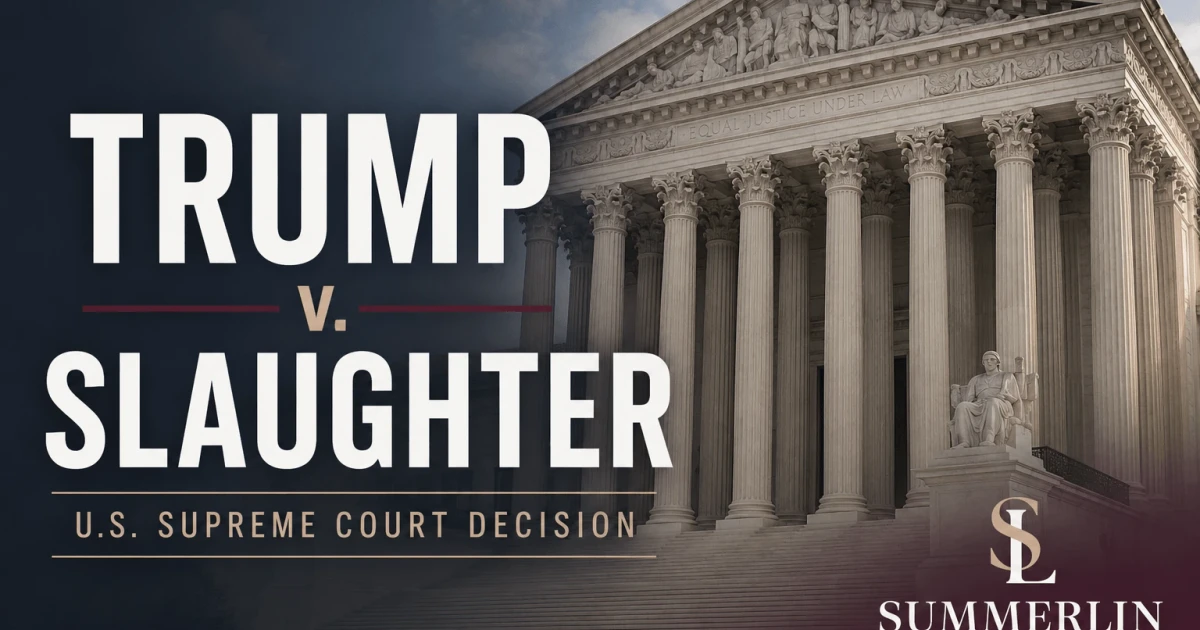
The Supreme Court gave President Donald Trump sweeping new authority over roughly two dozen multi-member agencies that Congress had intended to insulate from the White House, a shift that could make enforcement less predictable for major regulated industries. The 6-3 ruling in Trump v. Slaughter held that statutory for-cause removal protections for Federal Trade Commission commissioners are unconstitutional and overruled the 1935 precedent Humphrey’s Executor v. United States.
The case grew out of Trump’s firing of FTC Commissioner Rebecca Kelly Slaughter in March 2025. Slaughter and fellow commissioner Alvaro Bedoya said their terminations were illegal and planned to sue to reverse them. The court’s decision said the removal was lawful, effectively clearing the president to replace commissioners more easily and to pressure agencies whose leaders now know they can be removed without cause.
For business, the change is less about one commissioner than about the signals that govern compliance planning. Agencies that oversee antitrust, consumer protection, labor, health, safety and environmental issues now face stronger direct control from the White House, which can alter enforcement priorities with each administration. That raises the risk that mergers, investigations, rulemaking and penalties will track political turnover more closely, forcing finance, telecom, energy and other sectors to treat regulatory stability as a moving target.
The court paired that ruling with a separate decision preserving Federal Reserve independence for now, drawing a line around the central bank while widening presidential power elsewhere. The result leaves the rest of the independent-agency system exposed to sharper leadership turnover and more visible pressure from the executive branch, a major change for institutions Congress designed to operate at some remove from day-to-day politics.
Trump celebrated the decision as a “BIG WIN,” arguing that presidents must be able to hold regulators accountable. Critics warned it could bring chaos and weaken the long-standing check that independent agencies were built to provide, while legal commentators described the ruling as a major expansion of presidential power over the regulatory state.
Sources
- [1]nytimes.com
- [2]scotusblog.com
- [3]nbcnews.com
- [4]reuters.com
- [5]oyez.org