US News
Supreme Court Turns Down Virginia Democrats’ Redistricting Map
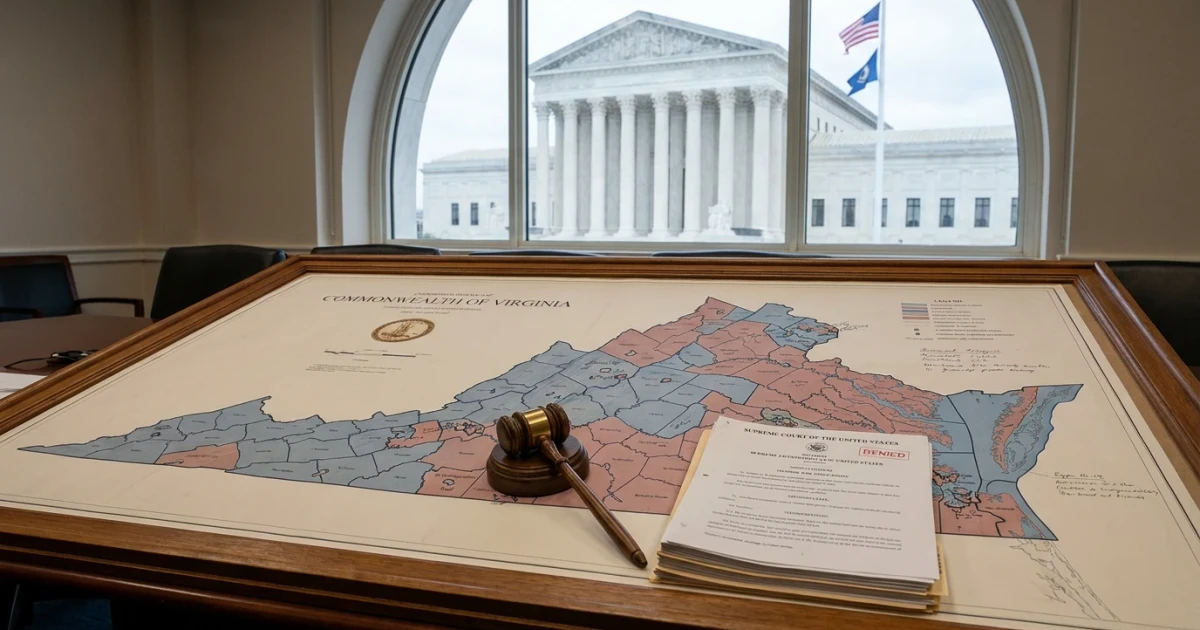
The Supreme Court has rejected an effort by Virginia Democrats to reinstate a congressional voting map that would have favored their party in upcoming elections, keeping the current district boundaries in effect. The decision, announced Thursday, ends a legal battle that had drawn national attention to the state's redistricting process and its potential impact on the balance of power in Congress.
Background: A Contentious Redistricting Battle
Virginia’s redistricting process has become a focal point in the ongoing debate over how congressional districts are drawn and who benefits from boundary adjustments. The effort to reinstate the Democratic-favored map emerged after a series of legal and legislative maneuvers following the 2020 census. Detailed information on changes to district lines, demographic impacts, and historical trends can be explored via the Virginia Public Access Project’s interactive redistricting maps.
As part of the process, the state relied on its bipartisan redistricting commission, established to limit partisan gerrymandering. More about the structure and function of redistricting commissions, including Virginia's, can be found through the National Conference of State Legislatures.
The Supreme Court Decision
The case, officially docketed as Supreme Court Docket 23A1055, centered on whether to overturn the current map. Virginia Democrats argued that the now-blocked map more accurately reflected the state’s population shifts and would ensure fairer representation. However, the Supreme Court’s decision leaves in place the map that critics say dilutes Democratic voting strength in several key districts.
The ruling holds significant implications for the 2026 congressional elections, as the current configuration is widely seen as more favorable to Republicans.
Impact on Voters and Elections
The Virginia Department of Elections estimates that thousands of voters will remain in districts where their influence may be diminished compared to the blocked plan. According to U.S. Census Bureau redistricting data, Virginia has experienced notable demographic shifts, with population growth concentrated in suburban areas that often lean Democratic.
- The blocked map would have likely increased Democratic-leaning districts from five to six out of eleven.
- The current map preserves a more even split, maintaining several competitive districts.
- Legal challenges to redistricting maps remain common, with ongoing lawsuits in multiple states, as detailed in the Brennan Center’s analysis of the redistricting landscape.
Analysis: Broader Implications
The Supreme Court’s decision underscores the high stakes of the redistricting process and the pivotal role courts play in shaping electoral outcomes. While proponents of independent commissions argue that these bodies reduce partisan influence, disputes over map fairness and representation are likely to persist.
As the 2026 elections approach, Virginia’s congressional races will proceed under boundaries that both major parties recognize as critical to control of the U.S. House. Voters and candidates alike must now adapt to the reality shaped by the Supreme Court’s ruling, as debates over redistricting fairness continue across the country.