Business
Teen summer jobs could hit lowest level since 1948

The weakest teen summer job market in more than seven decades is shaping up as more than a bad break for students hunting for seasonal work. It points to a labor market where employers are pulling back, cost pressures are still biting and the first rung on the employment ladder is getting harder to reach.
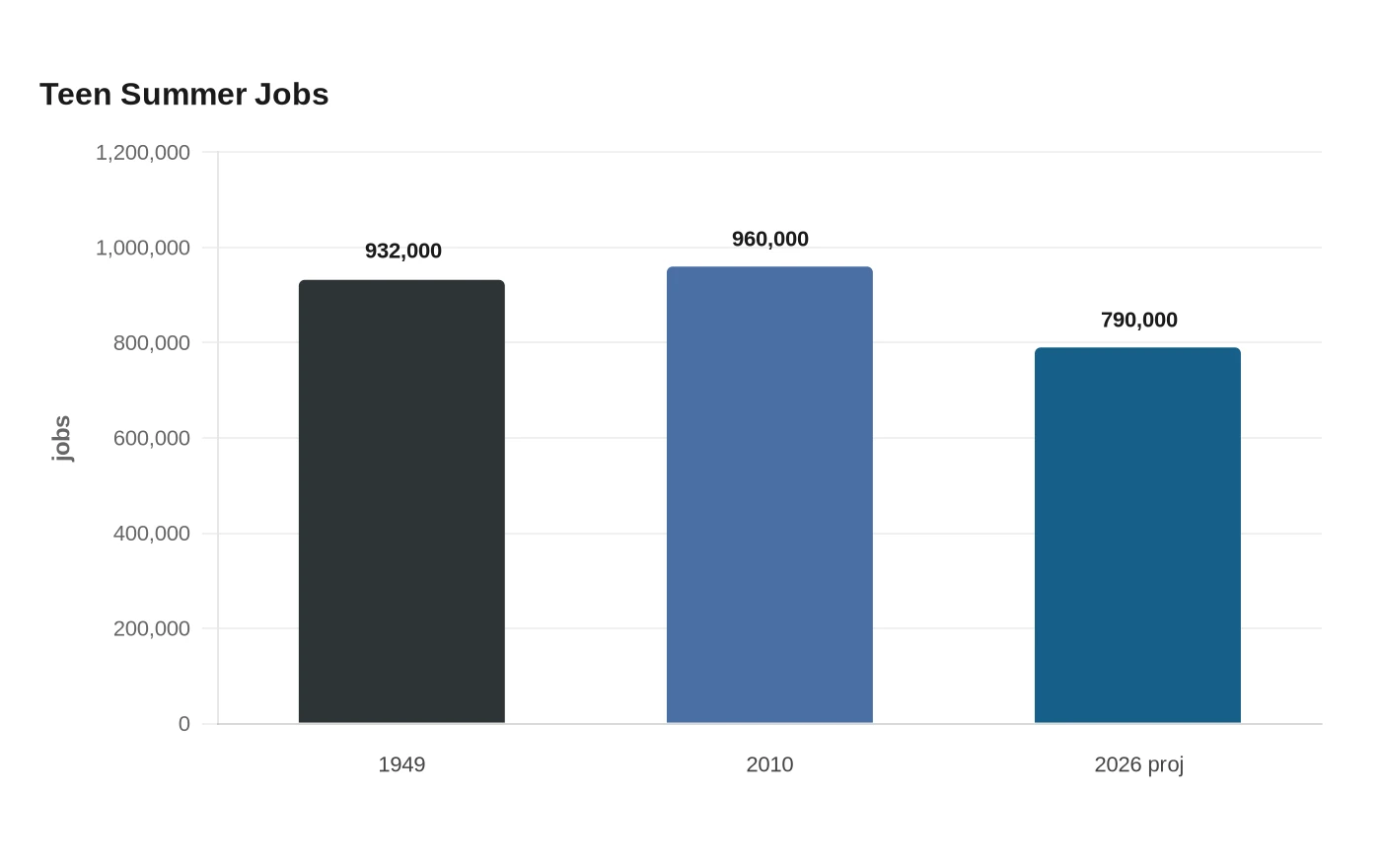
Challenger, Gray & Christmas projects teens will gain 790,000 jobs in May, June and July 2026, which would fall below last summer’s 801,000 and set a new low for the 77-year Bureau of Labor Statistics series that began in 1948. The prior benchmark for weakness was 932,000 in 1949, during post-war demobilization, while the previous post-1948 low was 960,000 in 2010, in the aftermath of the Great Recession.
The slowdown is visible in the broader teen labor market as well. In April 2026, 5,193,000 workers ages 16 to 19 were employed, down from 5,487,000 in April 2025. The teen labor force participation rate stood at 33.8%, and the employment-population ratio was 29.5%, both far below the levels that once defined summer work as a near-universal experience for many teenagers.
Andy Challenger, workplace expert and chief revenue officer at Challenger, Gray & Christmas, said the same cost pressures and demand uncertainty that weighed on hiring last summer were still present and, in some cases, worse. The firm points to inflation, climbing oil prices, higher fuel costs, automation and a cautious hiring climate as headwinds for businesses that usually absorb teen workers, including amusement parks, restaurants, retailers and summer camps.
Those are exactly the jobs that often serve as a first paycheck and a first lesson in showing up on time, handling customers and learning workplace routines. With fewer openings, teens are not just losing summer income. They are losing early experience that can shape confidence, references and future earnings.
Some analysts caution that the weakness may not signal a recession on its own. Teen schedules have changed, with sports, advanced placement classes, internships and other commitments competing for time once reserved for summer shifts. Still, the scale of the drop matters because teen employment often responds early when businesses grow wary.
The comparison now stretches from 1949 to 2010 to 2025, underscoring how unusual the current stretch has become. If this summer lands at 790,000 jobs, the message will be hard to miss: the path into the workforce is narrowing just as younger workers need those first openings most.
Sources
- [1]abcnews.com
- [2]challengergray.com
- [3]bls.gov
- [4]fred.stlouisfed.org
- [5]newsnationnow.com