World
Telegram faces global crackdowns as governments target its privacy model
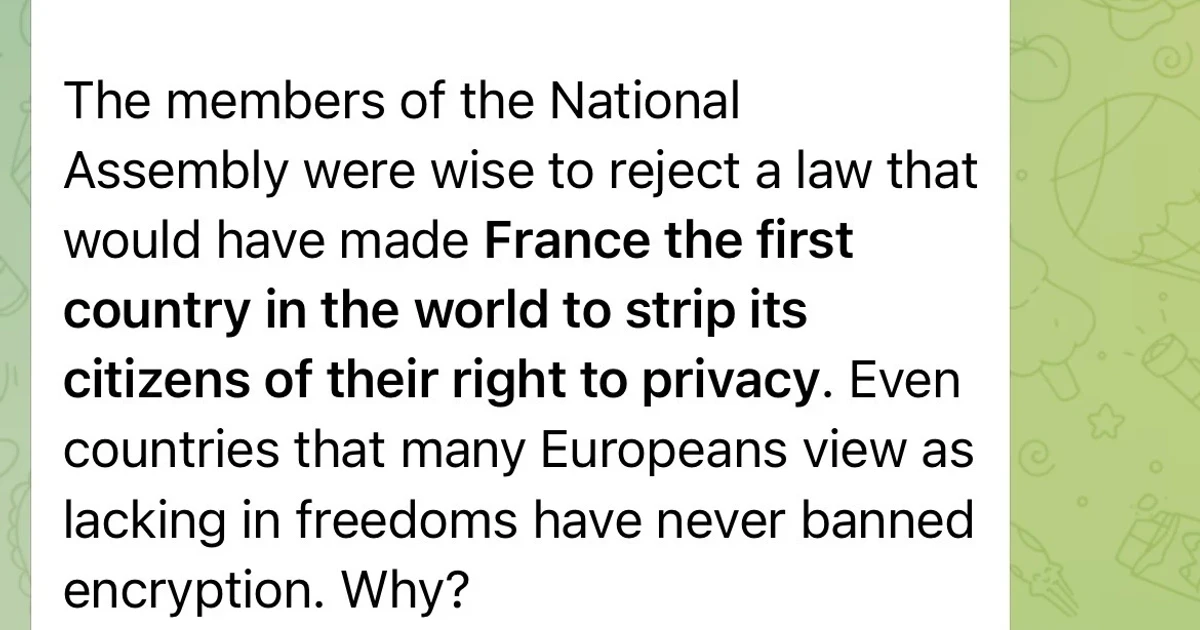
Telegram is being pulled into a global governance fight over the limits of privacy, speech and public safety. The app’s large public channels and semi-private groups can help dissidents, whistleblowers and ordinary users evade censorship, but those same tools can also be used to organize protests, circulate banned media, spread propaganda and coordinate illegal activity. That tension has made Telegram a recurring target for governments that say they are trying to stop crime, extremism and abuse without fully closing off encrypted communication.
Why Telegram has become such a flashpoint
Telegram’s defenders argue that the platform should not be treated as responsible for every act committed by its users. Its critics respond that a service built to minimize oversight can become a shelter for networks that move faster than conventional law enforcement, especially when messages are shared in channels that can reach huge audiences. The result is a dispute that is not just about one app, but about what obligations a platform should carry when it sits at the intersection of privacy, speech and security.
That question has become more urgent because the harms are not abstract. Governments point to drug trafficking, child sexual exploitation material, fraud, extremist propaganda and other illegal activity as proof that broad access plus limited moderation can create real-world damage. Telegram’s scale, and its reputation for resisting outside pressure, has turned it into a test case for whether states can demand more accountability without undermining the very privacy protections that some users depend on.
Russia set the first major confrontation
Russia was one of the earliest and clearest examples of that conflict. Authorities began blocking Telegram in April 2018 after the company refused to hand over encryption keys, making the dispute a direct clash between state surveillance demands and Telegram’s privacy stance. The block was formally lifted in June 2020, but the episode established a pattern that later governments would study closely: when access, secrecy and jurisdiction collide, the response can quickly become a blunt restriction.
That Russian case also showed why Telegram is politically fraught. For supporters of strong civil liberties, the refusal to surrender encryption keys looked like a necessary defense against state overreach. For officials, it looked like a company choosing opacity over cooperation while operating at a scale that could affect public order and criminal investigations.
France turned scrutiny into a criminal case
The French response pushed the issue beyond regulation and into criminal law. Pavel Durov, Telegram’s co-founder and chief executive, was arrested at Le Bourget Airport near Paris on August 24, 2024, then indicted on August 28, 2024, on charges including complicity in the distribution of child sexual exploitation material and drug trafficking-related offenses. He was placed under judicial supervision and barred from leaving France, turning Telegram’s governance crisis into a highly visible legal battle around platform responsibility.
Telegram responded by saying Durov had “nothing to hide” and arguing that a platform, or its owner, should not be held responsible for abuse committed by users. That defense reflects a broader philosophy that platform operators can facilitate communication without becoming the moral or legal guarantor of every conversation. French prosecutors, however, treated the platform’s design and oversight choices as part of the problem, not an excuse for it.
The French case mattered because it signaled that some governments are no longer satisfied with content takedowns alone. They want to know whether the platform’s structure, moderation systems and cooperation with investigators are sufficient to stop repeat abuse. In that sense, the case became a governance signal far beyond France: if a service is used at scale for both protected speech and criminal activity, how much responsibility should its executives bear?
Telegram’s own moderation model has changed under pressure
Telegram has tried to answer that question by pointing to its moderation systems. On its safety page, the company says it blocks tens of thousands of groups and channels every day, and that it has used machine-learning-based proactive monitoring since 2015. It also says that in 2024 it expanded automated child sexual abuse material detection using hashes from the Internet Watch Foundation and publishes daily transparency reports on terrorist content removals.
After the French case, Telegram updated its moderation policy in September 2024. The changes added clearer language about reporting private chats and expanded the company’s use of AI-based moderation and cooperation with authorities on valid legal requests. That shift suggests the company recognizes that its earlier hands-off reputation was no longer politically sustainable, even if it still insists on preserving a strong privacy model.
The moderation changes also reveal the core dilemma. More proactive detection can help remove harmful content faster, but every new layer of surveillance or automated filtering raises concerns about false positives, overreach and the erosion of private communication. For communities that rely on private messaging to avoid censorship or retaliation, those tradeoffs are not theoretical.
India shows how public safety arguments can broaden the crackdown

India has become another major flashpoint. In June 2026, authorities temporarily restricted Telegram over concerns tied to the NEET-UG re-examination, and Reuters reported the restriction was expected to last until June 22, 2026. The National Testing Agency said Telegram was being used by organized cheating networks and fraudsters, framing the case as an education integrity and public trust issue rather than a simple content moderation dispute.
Durov said the move had “punished” more than 150 million users in India, while arguing that the leaked material simply moved to other apps. That response underscores one of the hardest questions in digital governance: whether restricting a platform meaningfully reduces harm, or merely displaces it into another service with similar weaknesses. When enforcement sweeps broadly, the people who lose access are often far more numerous than the bad actors officials are trying to stop.
India’s case also shows how platform policy debates can spill into ordinary life. A temporary restriction aimed at cheating networks affects students, teachers, families and small communities that use the app for routine communication. The social cost of a crackdown is part of the policy calculation, not a side effect.
A widening international playbook, but no shared standard
Telegram has faced bans or restrictions in countries including China, Iran, Spain, Thailand, Belarus, Germany, the United Kingdom, Ukraine and Norway, among others. The justifications vary, from extremism and security concerns to copyright enforcement and disinformation. That patchwork reveals the absence of a global rulebook for platforms that operate across borders while offering tools that can protect vulnerable users and empower harmful networks at the same time.
What unites these governments is the belief that Telegram’s privacy model leaves too much room for abuse. What separates them is how much weight they give to free expression, due process and the risks of overblocking. Russia reached for encryption keys and a block, France reached for criminal charges, and India reached for a temporary restriction tied to alleged cheating networks, but each government is wrestling with the same deeper problem: how to regulate a platform whose best features are also its most controversial ones.
That is why Telegram is now more than a messaging app in policy debates. It is a stress test for modern governance, forcing states to decide whether public safety can be protected without flattening privacy and dissent into the same category as criminal misuse. However governments answer that question, the standard they choose will shape not only Telegram’s future, but the boundaries of digital speech itself.
Sources
- [1]nytimes.com
- [2]telegram.org
- [3]france24.com
- [4]politico.eu
- [5]business-standard.com
- [6]indianexpress.com
- [7]reuters.com