Science
Thackeray's Globules Offer Insights on Star Formation
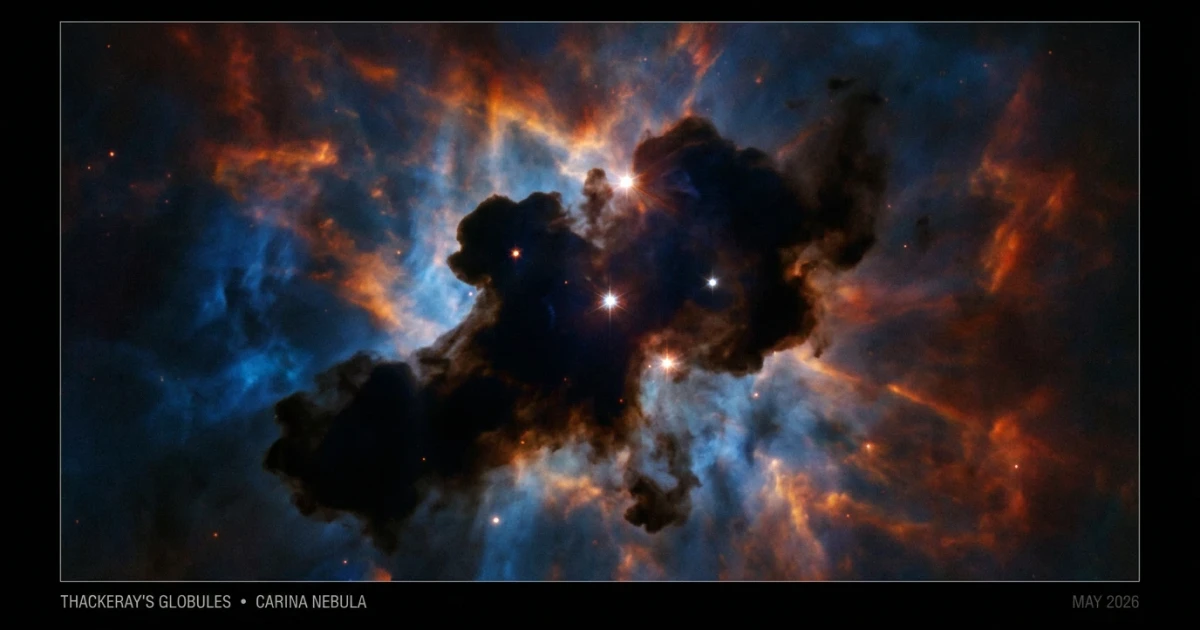
Thackeray's Globules, dense and dark clouds found in the Carina Nebula, are once again in the spotlight as NASA marks their significance in the ongoing quest to understand star formation. These enigmatic structures have been observed since their initial discovery, but modern telescopes and research continue to unveil new details about their composition, behavior, and role in galactic evolution.
What Are Thackeray's Globules?
Thackeray's Globules are compact, opaque clouds of gas and dust located within the Carina Nebula, a prominent star-forming region in the Milky Way. First noticed in the mid-20th century, they were named after astronomer A.D. Thackeray who identified their distinctive appearance. NASA's science page describes them as "dark patches against the bright background of ionized gas," highlighting their contrast and significance.
- Each globule is typically a few light-years across, though sizes vary.
- They contain dense molecular material shielded from intense radiation.
- These clouds are considered prime sites for stellar birth.
Observational Advances
NASA has utilized the Hubble Space Telescope and other instruments to study Thackeray's Globules in detail. High-resolution imaging reveals their intricate shapes and the way they interact with the surrounding nebula. These observations have allowed astronomers to measure properties such as mass, temperature, and density.
- Globules are often several solar masses in weight.
- They exhibit complex internal structure, with some showing signs of fragmentation.
- Radiation from nearby massive stars shapes and erodes the globules, sometimes triggering further star formation inside.
Role in Star Formation
According to NASA, Thackeray's Globules are "stellar nurseries," where gravity can collapse the dense material into new stars. As they evolve, these globules may form clusters of young stars, contributing to the ongoing cycle of stellar birth and death in the galaxy. The Carina Nebula itself is among the most active star-forming regions, making it a natural laboratory for studying the processes that govern cosmic evolution.
Scientific Impact and Future Research
Research into Thackeray's Globules not only furthers our understanding of star formation but also informs theories about planet formation and the origins of solar systems. With ongoing missions and advances in observational technology, scientists anticipate new discoveries about the globules' internal dynamics and their influence on the galactic environment.
NASA's continued focus on Thackeray's Globules underscores their importance in the broader context of astrophysics. As more data becomes available through projects like the HST Carina Nebula Campaign, astronomers will refine models of stellar evolution and gain deeper insights into the forces shaping our universe.
Conclusion
Thackeray's Globules in the Carina Nebula remain a cornerstone of star formation research. Their study, highlighted by NASA's latest observations, offers a window into the birth and evolution of stars, the dynamics of galactic environments, and the ongoing mysteries of cosmic creation. Continued exploration promises to reveal even more about these dark clouds and their pivotal role in the universe.