Science
The Sun’s Journey Around the Milky Way Explained
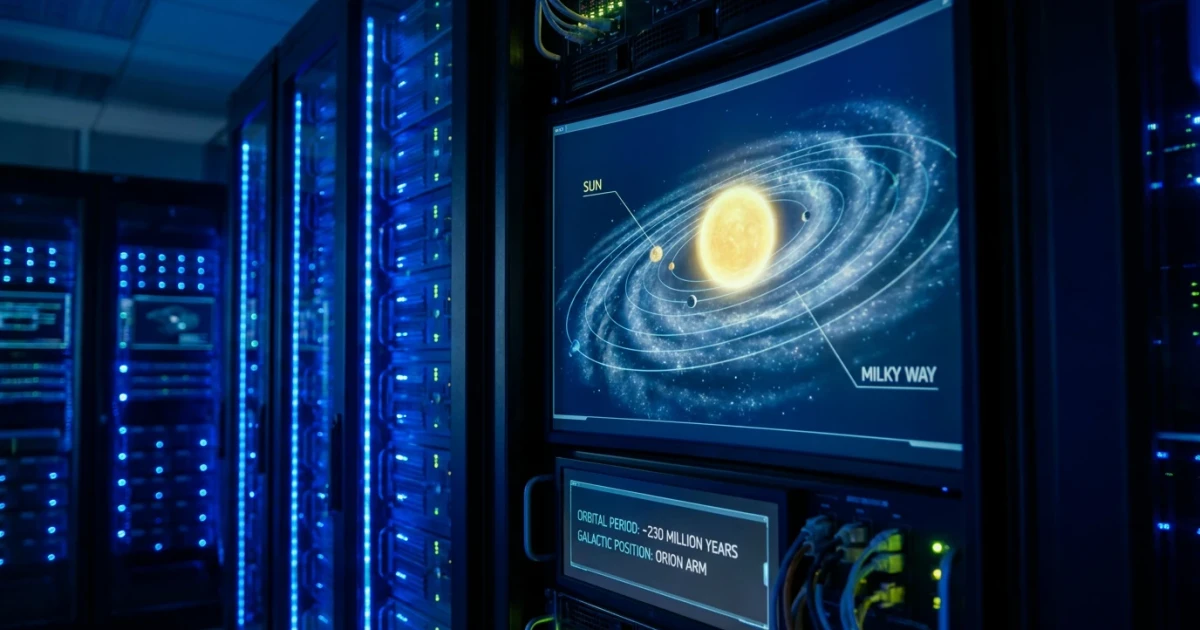
The Sun’s motion through the Milky Way is a phenomenon that shapes not only our solar neighborhood but also our understanding of Earth’s deep past. Far from stationary, the Sun pulls the Solar System in a vast orbit around the galaxy’s center—a single revolution that takes about 230 million years to complete. This immense cycle means that the last time our Solar System occupied its current position in the galaxy, Earth was in the Triassic Period, an era marked by the emergence of the first dinosaurs.
The Sun’s Path: A Galactic Orbit
The Milky Way is a sprawling spiral galaxy, and our Sun is just one of hundreds of billions of stars orbiting its center. According to data compiled by NASA and detailed in the NASA Sun Fact Sheet, the Sun travels at an average velocity of about 220 kilometers per second as it follows its nearly circular path around the galactic core. Over the course of each orbit—known as a galactic year—the Solar System traverses roughly 230 million years of cosmic history.
- The Sun orbits the Milky Way at about 220 km/s
- One complete orbit, or galactic year, lasts approximately 230 million years
- The Solar System is currently located about 26,000 light-years from the galactic center
Earth’s Place in Galactic History
This cosmic journey means that every time the Solar System returns to the same position in the Milky Way, Earth has undergone dramatic changes. The last lap was completed during the Triassic Period, a time when the supercontinent Pangaea was beginning to break apart, and the earliest dinosaurs were making their appearance. The NOAA notes that this era witnessed abrupt climate changes and significant evolutionary milestones.
Not a Static Solar System
Despite its seemingly unchanging position in our sky, the Sun’s galactic motion is a reminder that our Solar System is anything but static. The European Space Agency’s Gaia mission has provided detailed measurements of stellar motion throughout the galaxy, confirming that stars—including our Sun—move in complex orbits influenced by the Milky Way’s structure and mass distribution. Studies such as The Milky Way’s Rotation Curve and Mass have helped refine our understanding of how the galaxy’s stars circulate around its center.
- The Sun’s orbit is not a perfect circle; it oscillates slightly above and below the galactic plane
- Our Solar System passes through different regions of the galaxy, potentially encountering varying interstellar conditions
- These movements could influence cosmic ray exposure and, indirectly, conditions on Earth
Why the Sun’s Galactic Orbit Matters
Understanding the Sun’s orbit provides insight into both cosmic and terrestrial history. The length of a galactic year puts human history—and even the age of dinosaurs—into a broader context. In the time it takes for the Sun to travel around the Milky Way once, the face of our planet can be utterly transformed, highlighting the interconnectedness of astronomical cycles and Earth’s evolution.
Looking Ahead
As research continues, missions like Gaia and further analysis of galactic star clusters—found in resources such as the Milky Way Star Clusters Catalog—will refine our understanding of the Solar System’s trajectory through the galaxy. Each new discovery ties our planetary history ever more closely to the vast, ever-changing structure of the Milky Way.