Business
Trump Accounts could make kids millionaires, experts warn of catch
The headline promise is seductive: a Trump Account could grow into a million-dollar nest egg for a child. The fine print is less flattering, because the program’s math depends on a $1,000 seed, annual contribution caps, market returns and an opt-in structure that favors families already able to save.
How Trump Accounts actually work
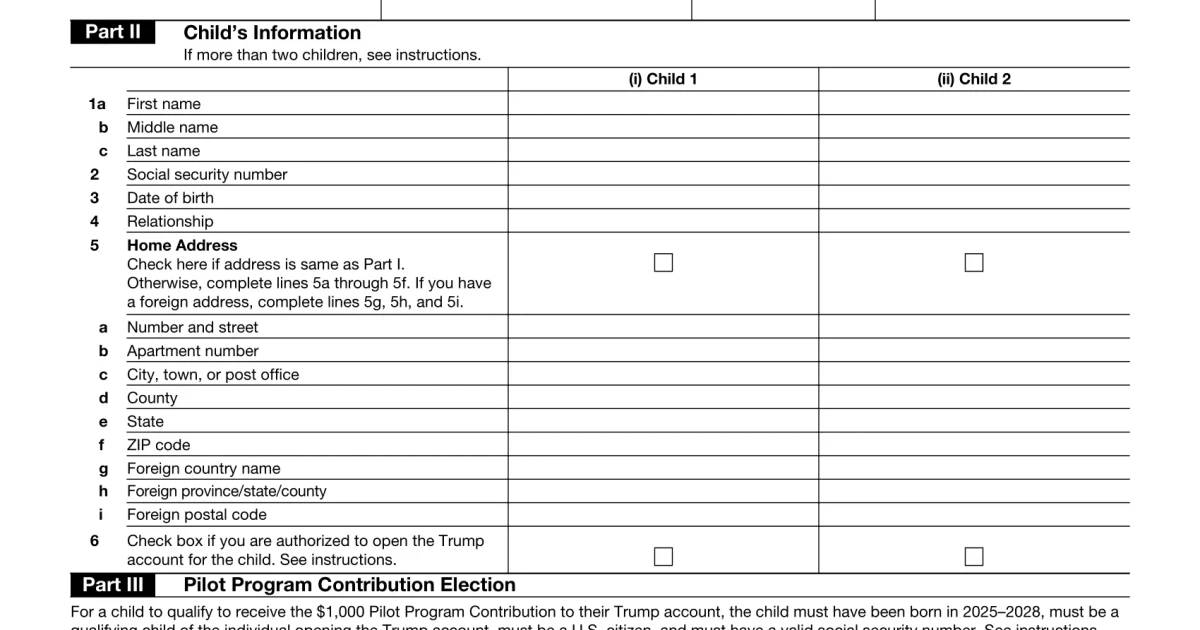
Trump Accounts, also called 530A accounts, are a new tax-deferred savings account for children under 18. The Internal Revenue Service says the child must not have turned 18 before the end of the calendar year in which the election is made and must have a valid Social Security number. Treasury and IRS guidance says a parent or other authorized individual has to elect the child into the program by signing into an IRS account and submitting Form 4547.
The federal pilot deposit is $1,000 for children born between Jan. 1, 2025, and Dec. 31, 2028, as long as they are U.S. citizens with valid Social Security numbers. Families can begin the process when filing 2025 tax returns. The White House says parents or guardians manage the account until the child turns 18, and that the account generally functions like a traditional IRA once the child becomes an adult.
That structure matters because it makes the account look less like a spendable cash stash and more like a long-term retirement wrapper. The money is meant to compound over time, but the rules also mean access is shaped by retirement-account mechanics rather than the flexibility of a basic bank account.
The millionaire claim runs on best-case math
The administration has suggested that Trump Accounts could make a child a millionaire by their late 20s. That is possible only under a very favorable set of assumptions: consistent contributions, strong investment performance and enough time for compounding to do the heavy lifting. Financial advisers have warned that actual returns can vary sharply, which makes the headline projection a scenario, not a guarantee.
Brookings says parents and employers can contribute up to $5,000 a year, indexed for inflation. Even if a family maxed out that limit from birth through age 17, the total principal would be about $91,000 before any investment gains, including the $1,000 seed. That is a long way from seven figures, which shows how much the millionaire pitch relies on market growth over decades, not just on the tax break itself.
The tax deferral helps because gains are not taxed along the way, so compounding is cleaner than in a taxable account. But tax deferral is not a magic trick. Without large and sustained contributions, the account can grow meaningfully and still fall well short of the kind of wealth the administration is advertising.
Who is actually positioned to benefit
Urban Institute researchers say the accounts are unlikely to build substantial wealth without a large initial deposit and continued contributions. That is the central consumer catch: the families most able to use the account as designed are the ones with spare cash to invest year after year. Wealthier households are also better positioned to take advantage of tax-advantaged accounts more broadly, which means the policy can amplify existing advantages instead of closing them.

Urban also warns that an opt-in design may reduce participation, especially among lower-income families. That matters because a program built around voluntary enrollment tends to favor households with time, tax filing stability and financial slack. Automatic enrollment would likely broaden access, but the current structure asks families to take the first step themselves.
The account’s age rules reinforce that point. The parent or guardian controls the account until age 18, and the child does not automatically gain access to unrestricted cash at the point of adulthood. In practice, that makes Trump Accounts more useful for patient wealth building than for near-term expenses like rent, tuition bills or a first-home down payment.
How it compares with 529s, baby bonds and other child accounts
Brookings and Urban both place Trump Accounts in a longer U.S. tradition of early-life wealth-building policy. The comparison set includes 529 plans, baby bonds and child development accounts, each of which tries to give children an early foothold in asset building. The similarities matter because they show this is not a brand-new idea, but a new version of an old debate about whether government should seed family wealth directly or simply subsidize private saving.
The distinction is in the purpose and the payoff. 529 plans are built around education, while Trump Accounts are framed as broader wealth-building tools that eventually operate like traditional IRAs. That makes the account potentially more flexible in theory, but also more distant from the immediate needs that many middle-class families actually face.
For families deciding whether the account is worth using, the practical question is not whether a millionaire outcome exists on paper. It is whether the rules, the contribution cap and the opt-in process make it realistic for ordinary households to accumulate enough to matter. On that standard, the account looks far more like a long-horizon retirement supplement than a fast track to a child’s first million.
The public-private layer could shape who gets ahead
In December 2025, CNBC and the White House said large private donors and companies, including philanthropists and financial firms, were being brought in to support the program. That gives Trump Accounts a public-private overlay that could influence how much money actually flows into them beyond the federal seed. It also raises a familiar policy question: whether private support will deepen access for well-connected families or help broaden participation across income groups.
That matters because a savings vehicle built around compounding only works at scale if families can keep contributing. If private money mostly complements households that were already able to save, the program will distribute opportunity unevenly. If enrollment stays opt-in and the annual contribution burden falls on families that are already stretched, the headline promise will remain more aspirational than transformational.
Sources
- [1]news.google.com
- [2]irs.gov
- [3]whitehouse.gov
- [4]cnbc.com
- [5]brookings.edu
- [6]urban.org