US News
Trump Faces Lawsuit Over Miami Presidential Library-Hotel Plan
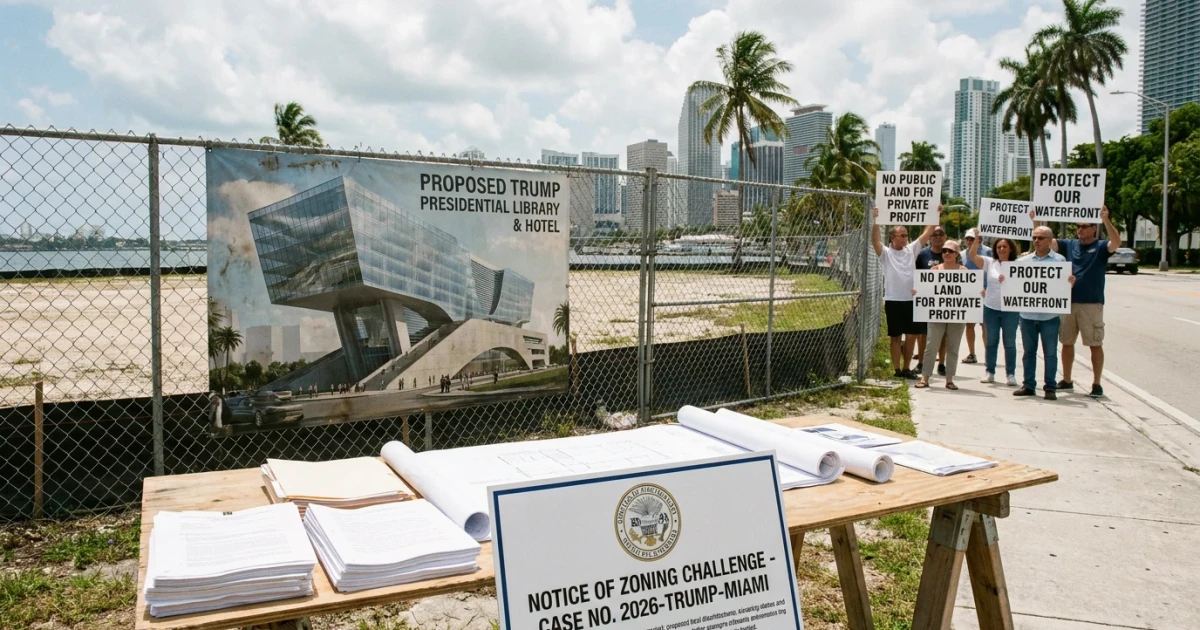
Donald Trump’s plans to build a presidential library on a coveted Miami waterfront plot—while also operating the facility as a luxury hotel—have sparked a significant legal challenge from local residents, highlighting the intersection of politics, real estate, and public land use.
Details of the Proposed Library-Hotel Project
According to The Washington Post, Trump’s proposal would establish his presidential library on a prime section of Miami’s shoreline, integrating traditional library functions with a high-end hotel and event venue. The project aims to attract both researchers and tourists, promising a blend of historical preservation and commercial activity. Trump’s team contends that such a facility would boost Miami’s profile as a destination for presidential history and luxury hospitality.
- The site selected for the library is a zoned waterfront parcel currently under municipal regulation.
- Plans include extensive public exhibits, conference spaces, and hundreds of hotel rooms, according to initial filings referenced by The Washington Post.
- The project would be unique among presidential libraries, which are typically non-commercial institutions managed by the National Archives.
Miami Residents Take Legal Action
The proposal has met with swift opposition from neighborhood groups and environmental advocates, who have filed a lawsuit in Miami-Dade County civil court. Plaintiffs argue that the development would privatize a portion of public waterfront, contradict existing zoning restrictions, and set a precedent for commercial encroachment on civic spaces. The court filing, accessible through the Miami-Dade County Civil Court Records Search, seeks to halt further planning and permitting until a full review can be conducted.
- Residents claim the project would "drastically alter" the character of the shoreline.
- The lawsuit cites potential violations of the Presidential Libraries Act and local land use laws.
- Environmental impact and increased congestion are also major concerns for opponents.
Legal and Regulatory Hurdles
Trump’s dual-purpose design is raising questions about compliance with federal law and local zoning codes. The Presidential Libraries Act outlines strict guidelines for site selection, funding, and management of presidential libraries, typically mandating non-profit operation and federal oversight. Attempts to blend private hospitality ventures with a federally recognized library could test the boundaries of existing regulation.
Moreover, the city’s zoning atlas—available via the City of Miami Zoning Atlas—shows the plot in question is subject to water access, environmental preservation, and public use restrictions, complicating any large-scale commercial development.
How Trump’s Vision Differs From Past Presidential Libraries
Most presidential libraries serve as research centers, archives, and museums, and are typically built with a combination of private donations and public support. According to federal library usage statistics, these institutions collectively host hundreds of thousands of visitors and researchers each year, but none operate as full-service hotels.
A Government Accountability Office report notes that financial and operational oversight of presidential libraries is already a challenge, raising questions about how a hybrid facility would be managed and regulated.
What Happens Next?
The lawsuit is likely to set a precedent for how presidential libraries can interact with commercial interests and public land policies. As legal proceedings unfold, stakeholders will watch for outcomes that could influence not only Trump’s plans but future projects seeking to blend civic and private uses on public land.
The story underscores the increasing complexity of presidential legacy projects in the modern era, as well as ongoing debates over public space, historic preservation, and the boundaries of private enterprise in civic institutions. Readers interested in the evolving framework for presidential libraries can review the Presidential Libraries Act and recent studies on facility planning and oversight for deeper context.