Health
UC San Diego surgeons use humanoid robots for gallbladder surgery tests

UC San Diego surgeons used two teleoperated humanoid robots to complete gallbladder surgery tests in pigs, including one operation in which a human-robot team removed a gallbladder and a second in which two humanoid robots worked together. The preclinical trial, published July 8 in Nature, marked the first time the team had used humanoid robots in an operating setting.
The experiments were done on large non-primate mammals and are being framed as a proof of concept, not a leap to human care. Researchers described the work as an early step toward introducing humanoid robots into the operating room, where the machines could first assist surgeons and later carry out procedures under teleoperation. Michael Yip, a UC San Diego professor of electrical and computer engineering who directs the Advanced Robotics and Controls Laboratory and the Healthcare and Medical Robotics Collaboratory, said the results show humanoid robots have a viable future in surgery.
The study, titled In vivo feasibility study of humanoid robots in surgery, was preclinical, meaning it took place before any human trials and still leaves major steps before patients could ever be treated this way.
Those steps include proving that humanoid robots can reliably handle the precision, speed and safety standards that surgery demands in real operating rooms. The system also still depends on surgeons for teleoperation, assistance and oversight, underscoring that the human role remains central. Even the most ambitious version of the project centers on a future autonomous surgical assistant, not a fully independent robot surgeon today.
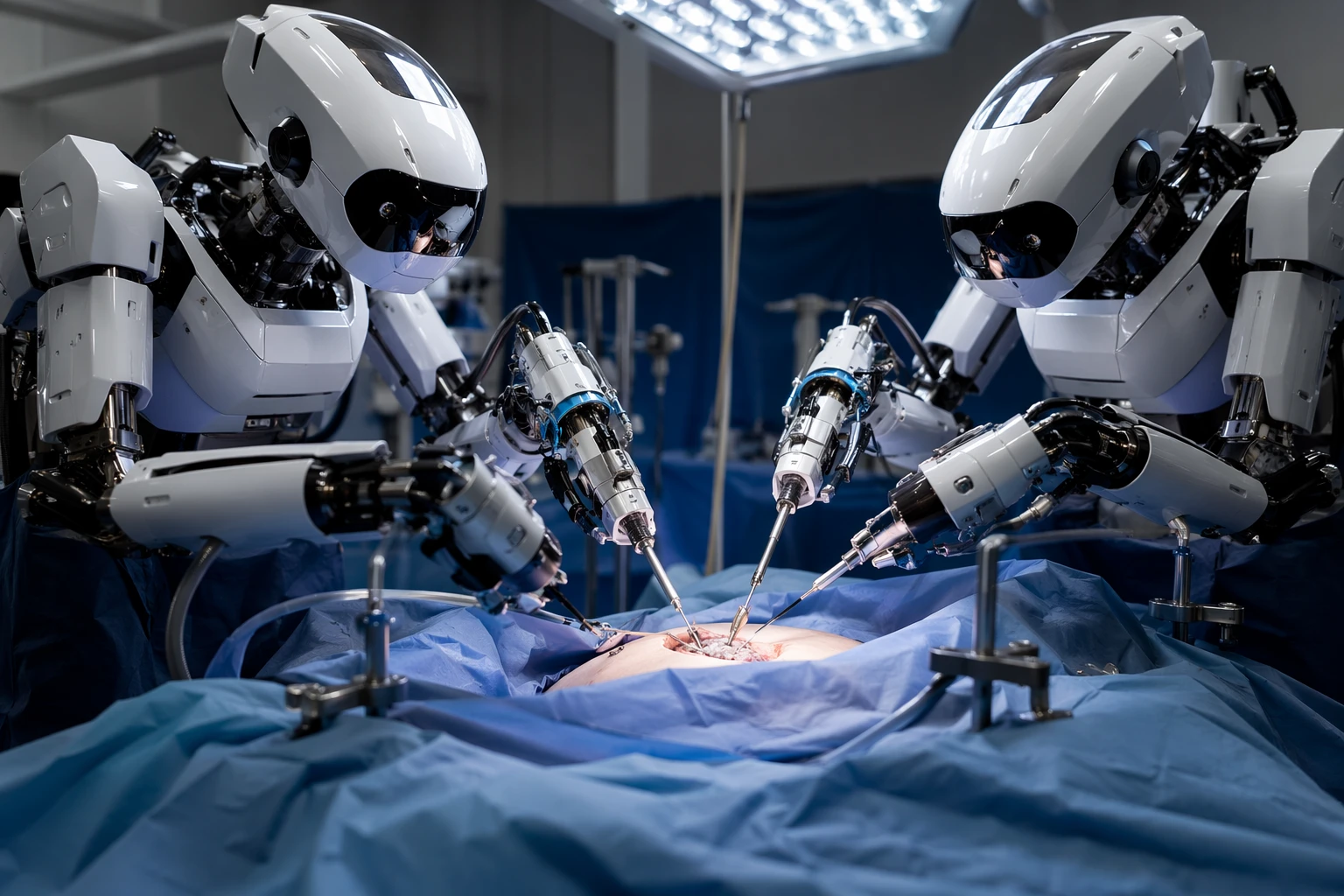
Specialized surgical robot systems usually weigh about 1,800 pounds, require a large team to set up and often force operating rooms to be retrofitted. Humanoid robots, by contrast, are mobile, more compact and potentially more versatile, which could make them easier to deploy in hospitals, remote communities and austere environments.
Yip said a general-purpose humanoid form factor could make sense over the long run in surgery. Such robots could eventually help with surgeon shortages, longer wait times, reduced access and healthcare disparities, with possible uses extending to search-and-rescue settings, battlefield medicine and even space.
Sources
- [1]abcnews.com
- [2]today.ucsd.edu
- [3]nature.com
- [4]ucsdarclab.com
- [5]yip.eng.ucsd.edu