World
UK eases UAE travel advice as Middle East tensions continue

Britain lifted its advice against all but essential travel to the United Arab Emirates on 18 June, easing a warning introduced after the US-Iran war erupted and stranded thousands of Britons across the Middle East. The Foreign, Commonwealth and Development Office kept the UAE on alert, but replaced the blanket restriction with guidance to prepare for a crisis, monitor local and international media, stay away from security and military facilities, and keep departure plans under review.
The shift came after a blunt escalation in early March, when the Foreign, Commonwealth and Development Office told British nationals in Bahrain, Israel, Kuwait, Lebanon, Palestine, Qatar and the UAE to register their presence so they could receive direct updates. The same advice urged travellers to monitor official guidance and follow local authorities. On 5 March, Keir Starmer said the UK would not join the initial US and Israeli strikes on Iran and warned that Iran had fired drones and missiles at ten countries that did not attack it, underscoring how quickly the conflict had spread beyond the original battlefield.

By 18 June, the government’s risk assessment had narrowed. The UAE page was updated the same day to reflect the removal of the advice against all but essential travel, but it did not signal a return to normal conditions. The Foreign, Commonwealth and Development Office still says travellers should make sure their travel documents are up to date and, if told to shelter, follow instructions from local authorities without delay.
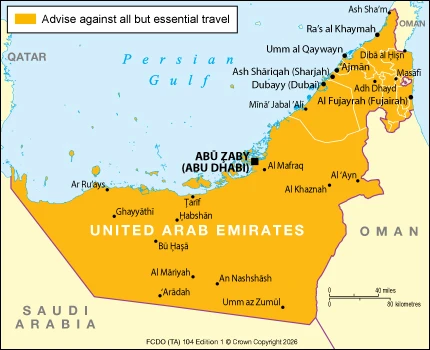
The regional picture remained volatile. The Bahrain travel advice page noted that in April there was a simultaneous closure of airspace and the King Fahd Causeway to Saudi Arabia, a reminder that transport links in the Gulf could still shut quickly when tensions rise. That kind of disruption is precisely what British officials are trying to manage through earlier registration, faster alerts and tighter monitoring of the region.
The UAE advice also still carries a broader warning that terrorism remains a threat worldwide and that terrorists are likely to try to carry out attacks in the United Arab Emirates. The policy change therefore amounts to risk recalibration, not reassurance: London has judged the UAE less dangerous than it was in the days of emergency escalation, but still a destination where sudden disruption, security threats and government travel interventions remain possible.
Sources
- [1]bbc.com
- [2]gov.uk
- [3]travelaware.campaign.gov.uk