Science
Unearthing the Ancient Giants: The Mysterious Lifeforms That Built Earth’s First Great Forests
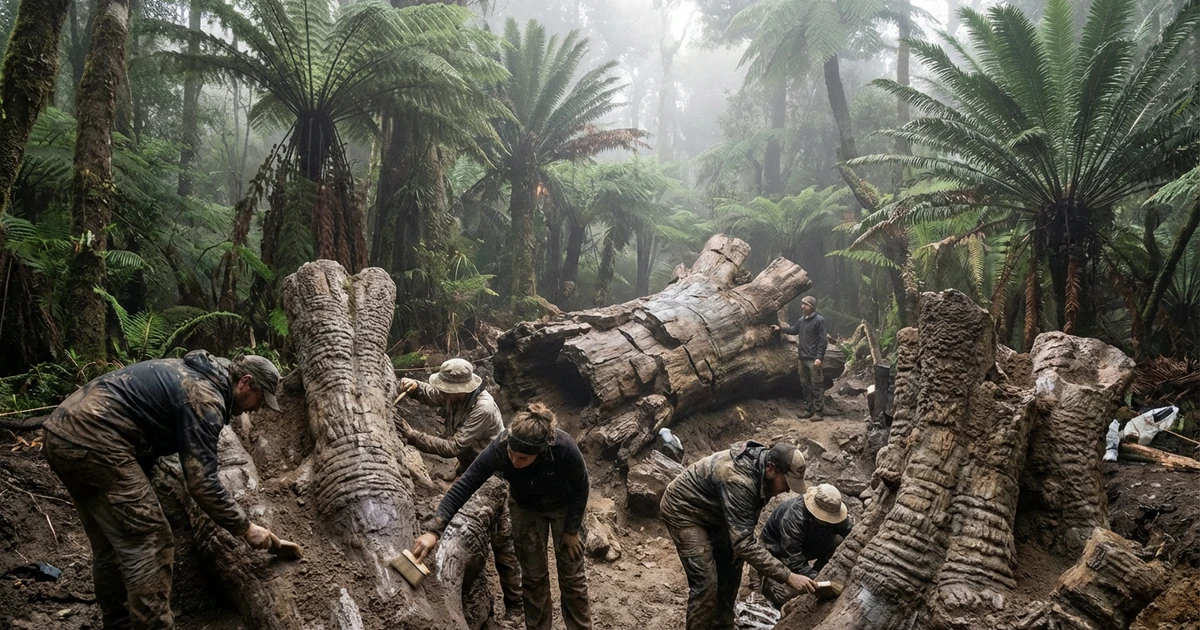
Earth’s first towering forests were not built by the ancestors of today’s trees or fungi—but by strange, ancient lifeforms with no living descendants, according to recent fossil discoveries and scientific analysis. The unearthing of Prototaxites fossils in Aberdeenshire and new research have brought fresh attention to these mysterious giants of prehistory, rewriting our understanding of early terrestrial ecosystems.
The Puzzle of Prototaxites: Neither Plant Nor Fungus
For over a century, paleontologists have debated the true nature of Prototaxites, a genus of fossilized organisms that dominated the landscape during the Devonian period, roughly 420 to 370 million years ago. These ancient lifeforms could reach up to 8 meters (26 feet) in height and up to a meter in diameter—dwarfing the earliest vascular plants of their time.
- Prototaxites formed vast, trunk-like structures that resembled logs but lacked the anatomical features of true trees.
- Early researchers debated whether these fossils represented primitive conifers, giant algae, or fungi.
- Modern research, however, suggests that Prototaxites belonged to a unique group of organisms with no direct living relatives.
Fossil Evidence from Aberdeenshire and Beyond
The addition of a Prototaxites fossil from Aberdeenshire to a museum collection has offered new insights into the scale and structure of these organisms, providing physical evidence of their presence in ancient Scotland. The fossil’s discovery underlines the global distribution of these giants, which have also been found in North America and other regions that were once part of the supercontinent Euramerica.
Detailed analysis of fossilized tissue shows that Prototaxites had tube-like structures, unlike those found in any modern plants or fungi. Their composition and growth patterns remain a subject of ongoing research, but their sheer size indicates they were the dominant lifeforms in early forests—providing shade and possibly influencing the evolution of other land species.
Redefining Earth’s Earliest Forests
While much of the modern world’s forests are defined by vascular plants, Prototaxites predated true trees by millions of years. During the Devonian period, the land was sparsely populated, with only small, simple plants and the enigmatic trunks of Prototaxites rising above the landscape.
- No living descendants: Prototaxites represents a completely extinct lineage, with no modern relatives among plants, fungi, or algae.
- Ecological impact: Their presence likely shaped early soils, microclimates, and the evolutionary trajectory of terrestrial life.
Continuing Mysteries and Scientific Debate
Despite advances in fossil analysis, the classification and biology of Prototaxites remain debated among scientists. Some studies have suggested a possible fungal affinity, but most experts now agree that these organisms were neither true fungi nor plants as we know them today. Instead, they represent a distinct and now-lost branch of the tree of life, highlighting the diversity of forms that once thrived on early Earth.
Looking Forward: The Legacy of Ancient Giants
The study of Prototaxites and similar fossils continues to reshape our understanding of Earth’s history. As researchers uncover more specimens and apply new analytical techniques, they hope to unravel the life cycles, ecological roles, and ultimate extinction of these remarkable organisms. Their story underscores the complexity of evolution and the many paths life can take—some of which leave no living legacy, but whose influence echoes in the layers of stone beneath our feet.
Sources
- [1]IFLScience