Science
Unusual Surge in Fireball Sightings Sparks Scientific Interest
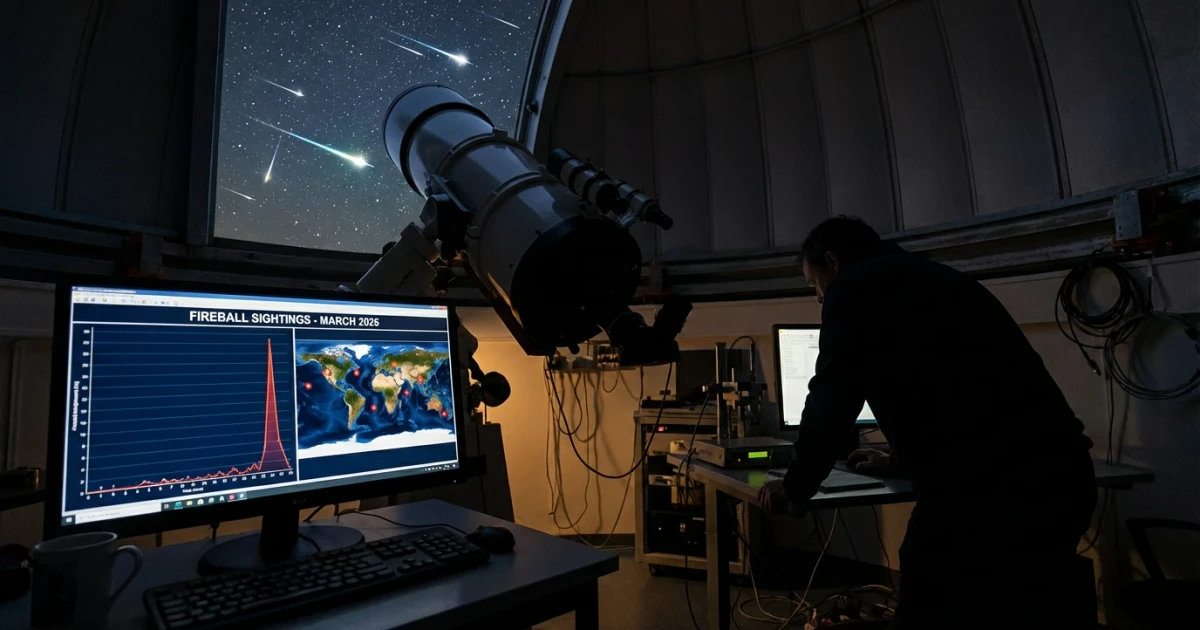
Unusually high numbers of fireball sightings have been reported around the world in 2026, with the United States seeing a notable uptick. The phenomenon is catching the attention of both the public and scientists, who are working to understand the reasons behind this sudden surge in bright meteors entering Earth’s atmosphere.
Sharp Increase Documented by Multiple Networks
Reports from meteor observation networks indicate that 2026 has seen a marked rise in fireball events—defined as exceptionally bright meteors that can often be seen over large areas. The American Meteor Society and NASA’s JPL Center for Near Earth Object Studies have both recorded a significant increase in events compared to prior years, with dozens of sightings logged in some months. Near real-time data from NASA Earthdata corroborates these trends, showing clusters of high-energy atmospheric entries across the continental US and beyond.
- Publicly reported fireballs in the US have spiked, with hundreds more logged than in typical years according to AMS fireball logs.
- Some events have been captured on video and shared widely, fueling both curiosity and speculation among skywatchers.
What Are Fireballs and Why Do They Matter?
A fireball is a meteor that burns much brighter than normal as it enters the atmosphere, often outshining Venus and sometimes even the Moon. Most fireballs result from space rocks—ranging from pebble to boulder size—burning up due to friction with the air. Occasionally, larger objects can survive the trip and reach the ground as meteorites.
While most fireballs are harmless, they are of scientific interest because they provide clues about the population of small near-Earth objects and help researchers assess potential impact risks. According to an analysis in ScienceDirect’s Global Fireball Frequency and Implications for Earth Impact Hazard, tracking these events helps planetary defense experts model the frequency and energy of objects entering the atmosphere.
Potential Causes Behind 2026’s Surge
Experts are examining several possible explanations for the uptick in fireballs:
- Increased debris from cometary or asteroid streams: Earth may be passing through a denser region of space dust or debris, possibly related to a recently fragmented comet or asteroid.
- Improved detection and reporting: Advances in camera technology, enhanced skywatcher networks, and real-time reporting tools mean more events are being documented than ever before.
- Random clustering: Variability in fireball frequency is expected, and short-term increases have occurred in the past, though 2026’s numbers are running higher than statistical predictions.
Scientists stress that while the current surge is notable, there is no evidence suggesting a heightened impact threat. NASA’s Planetary Defense Coordination Office continues to monitor the skies and assess any potential hazards from near-Earth objects.
Public Engagement and Scientific Value
The surge in fireball sightings has sparked renewed public interest in skywatching and amateur astronomy. Crowdsourcing platforms and observation networks rely on community reports to improve their data. This collaborative approach helps scientists study the origin, frequency, and composition of these events, feeding into larger efforts like the Global Fireball Observatory project, which aims to build a global record of bright meteor events.
Looking Ahead
As 2026 continues, researchers will analyze whether the fireball surge persists and investigate possible links to periodic meteor showers or new debris streams. Ongoing data collection from government sensors, observatories, and citizen scientists will be essential in unraveling the causes and implications of this unusual year for fireballs around Earth.