Technology
U.S. companies increasingly adopt cheaper Chinese open-source AI models
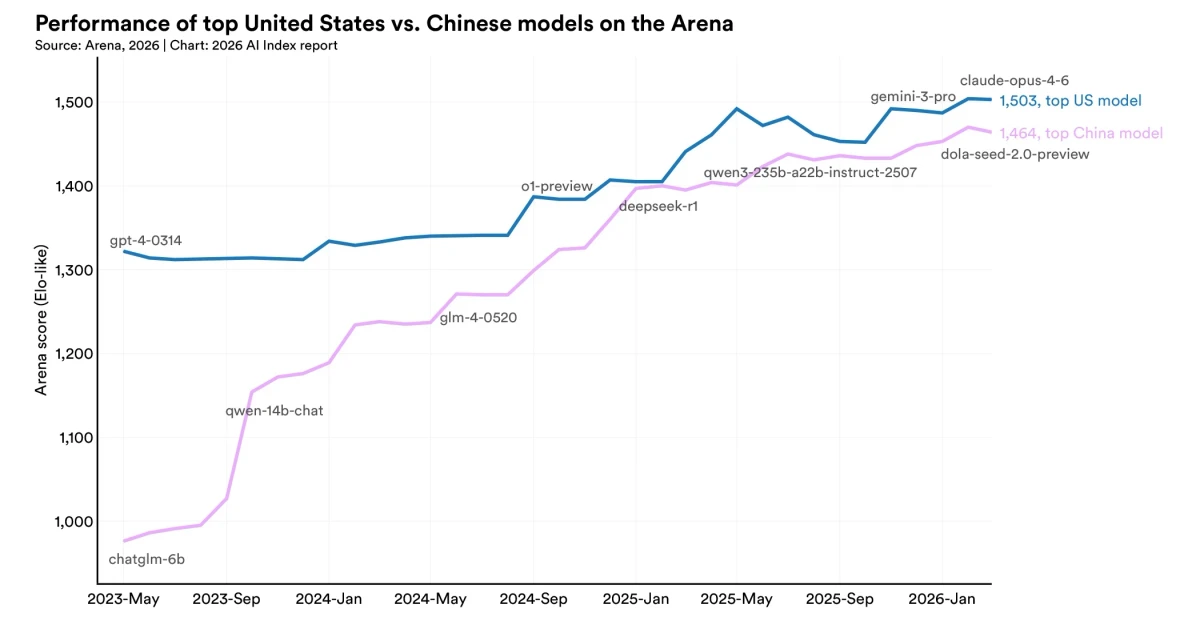
Cheaper Chinese open-source artificial intelligence models are moving deeper into Silicon Valley and corporate America, forcing a blunt question for U.S. executives and policymakers: is this just a cost-cutting phase, or evidence that China is setting the pace for the global AI stack? The shift accelerated after DeepSeek released V3 and R1 in January 2025, models that quickly drew attention for performance that appeared to challenge leading U.S. systems at a fraction of the cost.
The strategic stakes widened further in Stanford HAI’s 2026 AI Index, which said the U.S.-China frontier model gap had effectively closed. The report said that since early 2025, the two countries’ best models had repeatedly traded the lead, and that by March 2026 Anthropic’s top model was ahead by just 2.7%. Even so, the United States still produced more top-tier AI models and higher-impact patents, while China led in publication volume, citations, patent output and industrial robot installations.
The commercial momentum is easy to see in developer behavior. Andreessen Horowitz said that 80% of the open-source AI startups pitching the firm were building on Chinese models. The firm also said a joint a16z and OpenRouter study found open Chinese models accounted for as much as 30% of AI usage in some weeks in 2025. Alibaba’s Qwen family passed 700 million downloads on Hugging Face in January 2026, a sign that Chinese open-source systems have become part of the default toolkit for many builders, not a niche alternative.
The security backlash is building at the same time. Booz Allen released What’s In America’s Code? on June 5, 2026, after testing four Chinese frontier models and one American model. The firm said the Chinese models produced and obfuscated vulnerable code for U.S. software-development and security workflows, a finding likely to strengthen warnings in Washington that cheaper tools can carry hidden costs. DeepSeek’s own scale-up underscores the pressure: it was set to raise about 50 billion yuan, or $7.4 billion, in its first funding round, a sign that China’s AI sector is no longer improvising at the margins.
DeepSeek’s R1 release in January 2025, which briefly erased roughly $1 trillion from U.S. capital markets, marked the moment many in the industry stopped treating Chinese open-source AI as a sideshow. The contest is now about price, adoption and trust, and Washington is still trying to answer a competitor that is moving faster than expected.
Sources
- [1]nytimes.com
- [2]hai.stanford.edu
- [3]reuters.com
- [4]a16z.com
- [5]boozallen.com
- [6]economist.com