Business
U.S. container imports jump as companies rush goods ahead of tariffs
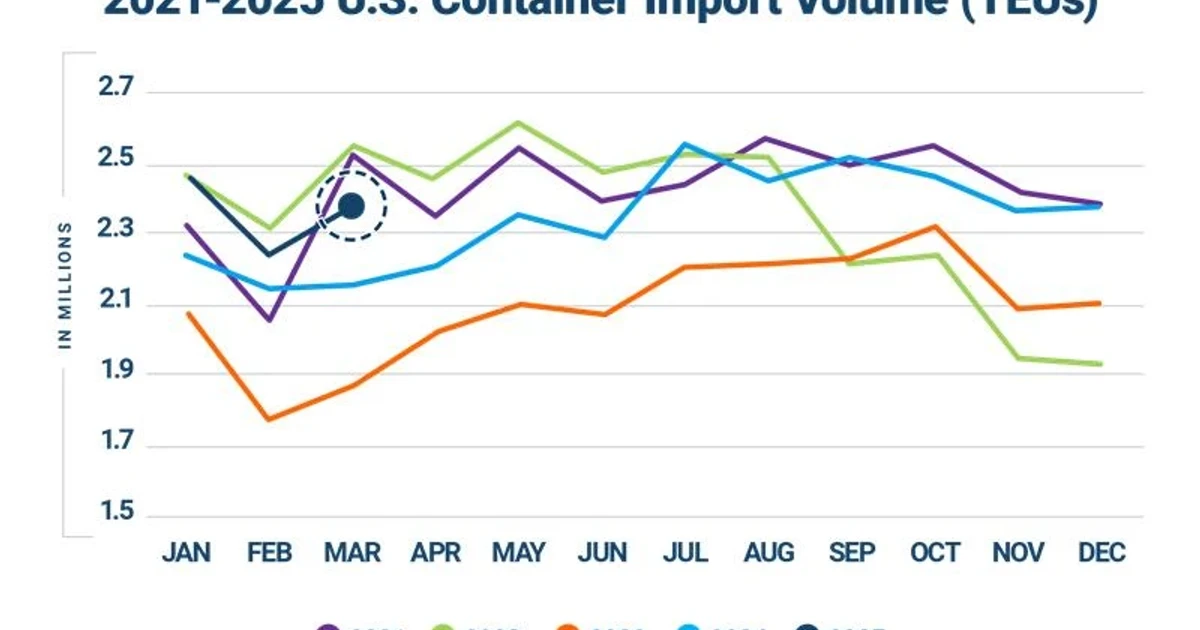
U.S. container imports climbed 8.2% in June to 2,400,627 twenty-foot equivalent units as retailers, manufacturers and other buyers rushed goods into the country before higher ocean freight bills and fresh tariff risks could hit. Descartes Systems Group said the spike came as shipping costs tied to the war in Iran began feeding through to transportation contracts, giving importers a strong incentive to move cargo early.
China drove most of the increase. Imports from China rose 27.4% from a year earlier to 814,474 TEUs in June, a sign that front-loading was especially pronounced on the biggest Asia-U.S. trade lane. Even with that rebound, U.S. container imports for the first half of 2026 were still down 0.3% from the same period in 2025, showing that June’s surge did not fully erase the earlier softness in trade volumes.
The month-over-month pattern also points to a pull-forward rather than a broad demand boom. Descartes said June imports were down 1.2% from May, a decline it described as normal seasonal easing after May’s stronger results. In May, U.S. container import volumes had already risen 6.6% from April to 2,428,758 TEUs, suggesting the spring started with already-active buying before June’s sharper rush.
Freight costs are adding to the pressure. The cost of shipping a container from Asia to the United States has doubled since the start of the Iran war, as spiking fuel prices and importer demand pushed rates higher. Carriers including MSC, CMA CGM, Ocean Network Express and Maersk have begun applying fuel surcharges and higher rates across trade lanes, raising the risk that landed costs will keep climbing even if cargo volumes cool later in the summer.
Tariff policy is the other major force behind the rush. A hearing on the U.S. Trade Representative’s latest forced-labor tariff plan began in Washington on July 8, while 22 Democratic state attorneys general have opposed proposed tariffs of up to 12.5% on 59 countries and the European Union over alleged failures to curb forced-labor-linked goods. U.S. Customs and Border Protection has already detained about 42,000 shipments worth nearly $4 billion under the Uyghur Forced Labor Prevention Act between June 2022 and February 2026.
The combination of higher fuel-linked freight charges, tariff uncertainty and stepped-up enforcement is pushing importers to bring goods in now, leaving retailers with fuller warehouses today and a greater chance of price pressure later.
Sources
- [1]money.usnews.com
- [2]descartes.com
- [3]energynow.com
- [4]supplychaindive.com
- [5]msn.com
- [6]supplychainbrain.com