US News
US data centers drive power demand and grid reliability fears
The AI boom is running into a harder constraint than software: electricity, water, and local consent. U.S. data-center power use jumped from 58 TWh in 2014 to 176 TWh in 2023, and a July 2024 fault in northern Virginia briefly knocked 60 data centers off the grid at once.
The scale of the buildout
Lawrence Berkeley National Laboratory, echoed in U.S. Department of Energy summaries, says data centers accounted for about 4.4% of U.S. electricity consumption in 2023. Its forecast points to another steep climb, with national data-center demand projected to reach 325 TWh to 580 TWh by 2028. That is not a marginal increase. It is a shift large enough to change how utilities plan transmission, generation, and reserve margins.
The numbers help explain why data centers have become one of the clearest stress tests for the AI economy. Every new cluster of servers brings a heavy, steady load that is hard for local systems to absorb quietly. When demand rises this quickly, the question is no longer only whether the next model can be trained faster. It is whether the grid, the water system, and the permitting process can keep up with the campuses that support it.
Northern Virginia is the front line
Nowhere shows that strain more clearly than Northern Virginia, which state and industry reports describe as the world’s largest data-center market. The Northern Virginia Technology Council says the industry generated nearly $40 billion in statewide economic impact in Virginia in 2025, supported more than 112,000 jobs, and contributed over $1.5 billion in annual state and local tax revenue. Those figures explain why local officials keep approving more development even as the backlash grows.
That concentration also creates risk. When so much of one industry sits in one corridor, a single fault can have outsized consequences for the regional grid. Northern Virginia has become both the business case for large-scale digital infrastructure and the cautionary tale for what happens when that infrastructure stacks up faster than power planners expected.
What the 2024 near-miss revealed
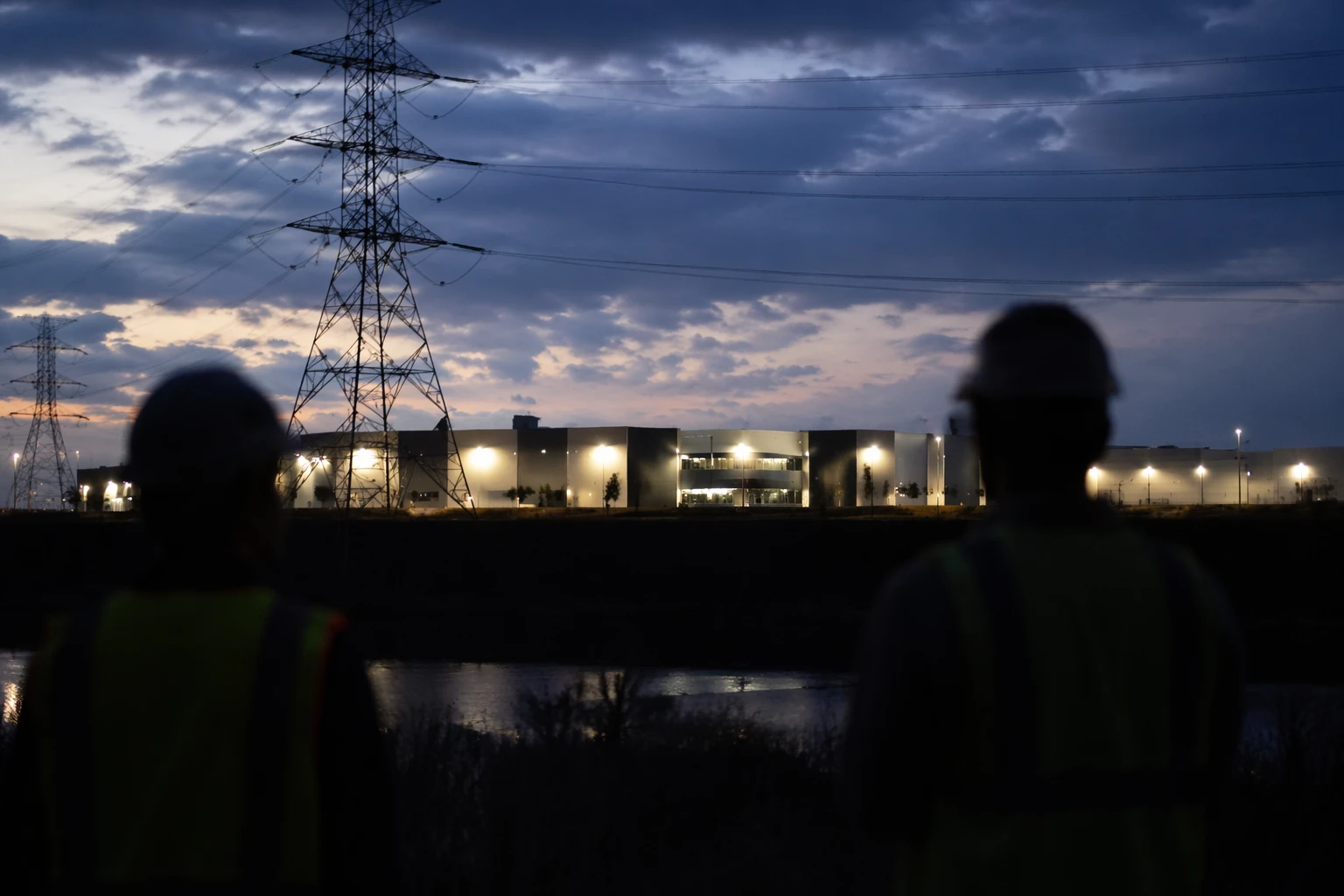
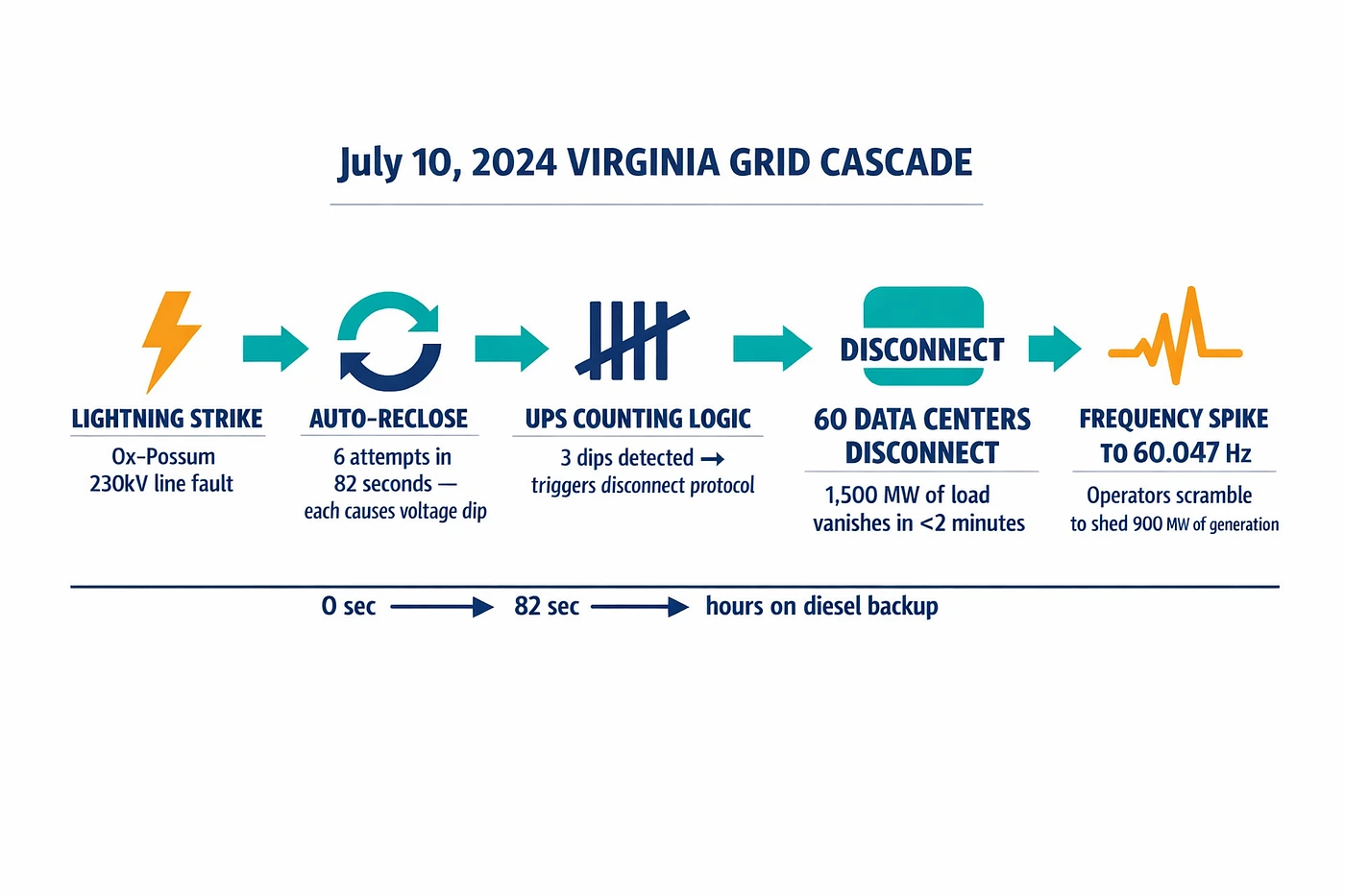
On July 10, 2024, at about 7:00 p.m. Eastern, a lightning arrestor failed on a 230 kV transmission line in northern Virginia. The event triggered the simultaneous disconnection of roughly 60 data centers and caused about 1,500 MW of load loss, all of it data center-type load. The North American Electric Reliability Corporation said the grid had not historically experienced simultaneous load losses of that magnitude in response to a fault.
That matters because grid reliability is built around handling failures, but not every failure looks the same. A clustered data-center market can behave like a single giant customer when the same voltage fluctuation pushes multiple sites off-line at once. For PJM Interconnection and Dominion Energy, the practical lesson is that the region is no longer dealing with isolated facilities. It is managing a concentration of demand large enough to move the system when something goes wrong.
The near-miss also sharpened the policy debate beyond technical circles. Once an incident like that hits, concerns about backup systems, transmission strength, and operating rules move from abstract planning to questions local governments can understand: how much load is being added, where it will go, and what happens if a fault hits at the wrong time.
Why resistance is spreading
Public opposition has been rising because the costs are no longer invisible. Communities are pushing back over electricity bills, environmental impacts, and local community effects, with zoning fights becoming one of the most common ways resistance shows up on the ground. In practice, that means county hearings over land use, utility studies that slow approvals, and neighborhood campaigns that focus on how much water and power a new campus will need.
The politics are shifting because the benefits and burdens are landing in different places. The tax revenue and jobs are real, and Virginia’s figures make that plain. But the local debate is increasingly about who pays for substations, transmission upgrades, and the strain on nearby infrastructure when the next wave of AI-related demand arrives.
Water use adds another layer of conflict, especially in areas already sensitive to drought, growth, and industrial siting. Even when a data center does not consume the same water as a factory, it can still draw enough attention to make residents question whether their county is trading long-term flexibility for short-term revenue. That is why opposition is building not just from environmental groups but from residents who see data-center expansion as a direct claim on their electricity, land, and local autonomy.
The next brake on the AI boom
The AI buildout now faces a constraint that software vendors cannot solve alone. The projects that once seemed like a straightforward vote for jobs and tax revenue are increasingly judged against grid reliability, zoning capacity, and local willingness to absorb another heavy load. Northern Virginia shows both sides of the ledger at once: a market that generates billions and a system that came close to exposing how fragile concentrated demand can be.
That is why the next front in the AI boom is unfolding at county boards, utility hearings, and transmission planning tables. The central fight is no longer just about what AI can do. It is about where the power will come from, how much water it will use, and how much local consent the industry will need before the next campus gets built.
Sources
- [1]theverge.com
- [2]newscenter.lbl.gov
- [3]energy.gov
- [4]nerc.com
- [5]belfercenter.org
- [6]nvtc.org
- [7]thehill.com
- [8]brookings.edu
- [9]jlarc.virginia.gov
- [10]congress.gov