Health
U.S. infant mortality falls to record low, still trails peers

The United States reached a new low in infant mortality last year, but the improvement only sharpened a familiar paradox: American babies were dying less often, yet still at a rate well above other wealthy countries. The latest federal estimates put the 2025 rate at slightly below 5.4 deaths per 1,000 live births, down from 5.52 in 2024 and 5.61 in 2023.
That shift looks small on paper, but it is statistically meaningful and translates into hundreds fewer infant deaths. The Centers for Disease Control and Prevention said its quarterly provisional estimates were based on death records processed by the National Center for Health Statistics through April 12, 2026, with 2025 birth denominators still provisional. The agency counts infant deaths as those occurring before a baby’s first birthday, while neonatal mortality covers the first 27 days of life and postneonatal mortality runs from 28 days through 11 months.

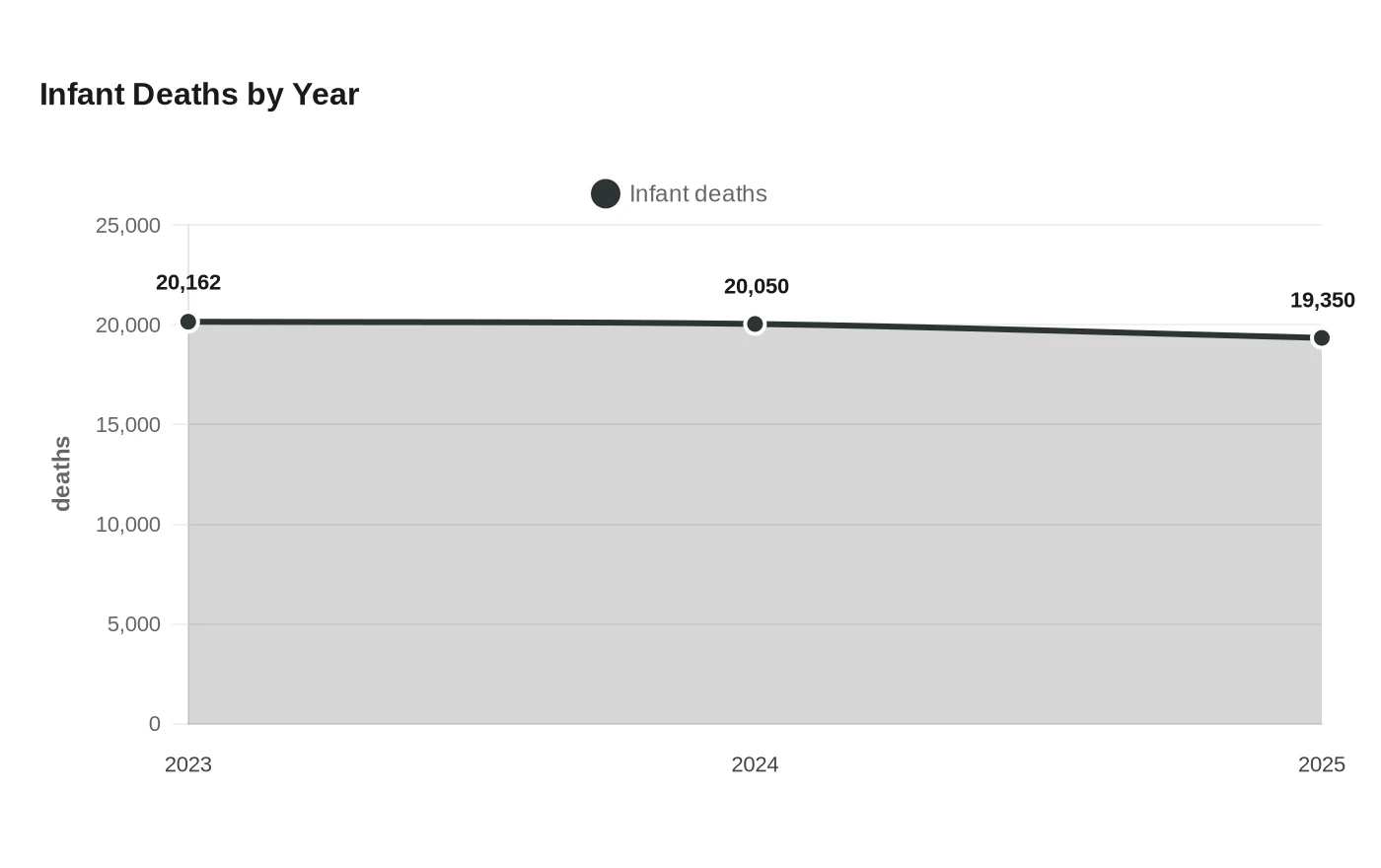
The raw count also fell. Federal data put infant deaths at about 19,350 in 2025, below the 20,050 recorded in 2024 and the 20,162 reported for 2023. Researchers caution that rates matter more than counts because the number of births changes from year to year, but the direction is clear: the nation is still improving, even if only gradually.

Some of that progress may reflect stronger protection against respiratory infections in infants and pregnant women. In 2023, the U.S. Food and Drug Administration approved Pfizer’s maternal RSV vaccine, Abrysvo, on Aug. 21, and the Advisory Committee on Immunization Practices recommended it on Sept. 22. CDC guidance says pregnant women should receive a single dose between 32 and 36 weeks of pregnancy, typically from September through January. Anne K. Driscoll of the March of Dimes said those measures likely helped drive improvement in 2024. The March of Dimes has also pushed safe-sleep education, stressing that babies should be placed on their backs on a firm, flat surface and kept away from bed-sharing and soft bedding, a practice linked to lower sudden infant death syndrome risk.
The leading causes of infant death remain congenital malformations, disorders related to short gestation and low birthweight, and sudden infant death syndrome. That is why the broader policy challenge extends beyond one year’s data. The Commonwealth Fund found the U.S. infant mortality rate at 5.6 deaths per 1,000 live births in 2023, placing it between Qatar and Romania in one international comparison. Experts often tie the gap to poverty, limited prenatal care and other social and medical problems, even as the U.S. has cut its rate from roughly 7.5 per 1,000 three decades ago. Infant mortality remains a blunt measure of how healthy a society is, and the latest record low shows that public health policy still has room to move the numbers.
Sources
- [1]usnews.com
- [2]cdc.gov
- [3]commonwealthfund.org
- [4]marchofdimes.org