Business
U.S. jobless claims rise less than expected, signaling steady labor market

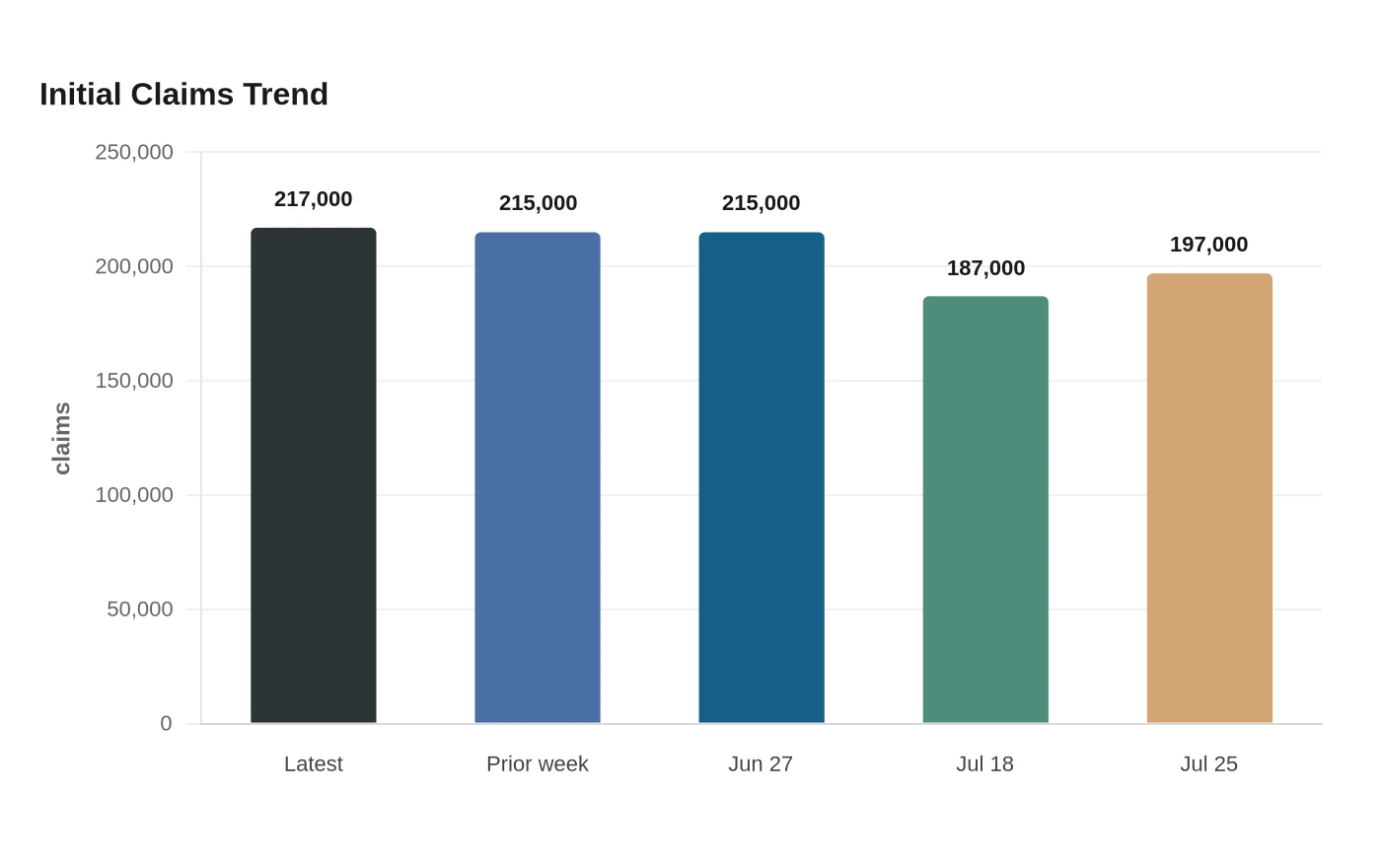
U.S. initial jobless claims edged up to 217,000, a smaller increase than economists expected, even as hiring has cooled from the post-pandemic rebound. The latest reading left layoffs looking restrained rather than rising, with continuing claims holding at 1.95 million and the four-week moving average easing to 224,500.
The weekly claims data remain one of the fastest real-time gauges of labor stress because they capture newly filed applications for benefits before broader job-market trends show up in unemployment figures. In the latest report, claims rose from 215,000 the prior week but came in below the 225,000 consensus forecast, a sign that employers are still avoiding broad cuts despite weaker growth, tariff uncertainty and softer global demand.
That pattern has run through much of 2026. The U.S. Department of Labor reported 215,000 initial claims for the week ending June 27, while later readings showed much lower levels: Trading Economics put initial claims at 187,000 for the week to July 18 and continuing claims at 1,796,000, and Haver Analytics said new claims rose to 197,000 in the week of July 25 after the prior week had reached the lowest level since 1969. Taken together, those figures show a labor market that has slowed without breaking.
The broader backdrop helps explain why the latest claims number did not alarm markets. The Federal Reserve’s July Monetary Policy Report said the labor market remained solid, and the unemployment rate was 4.2% in June, according to the Bureau of Labor Statistics. The Federal Open Market Committee held interest rates steady at its July 29 meeting, reinforcing the view in Washington that a single modest rise in claims is not enough to justify a rapid policy shift.
For workers, that mix means jobs are still relatively secure, even if opportunities are less plentiful than during the rebound. For employers, it suggests caution: businesses are not rushing to add staff, but they are also not cutting aggressively. That keeps consumer spending supported, while giving the Fed less reason to move quickly on rate cuts unless weaker hiring starts to show up more clearly in the claims data.
Sources
- [1]reuters.com
- [2]dol.gov
- [3]investing.com
- [4]tradingeconomics.com
- [5]haver.com
- [6]federalreserve.gov
- [7]bls.gov