Business
US labor share of GDP falls to record low as productivity surges

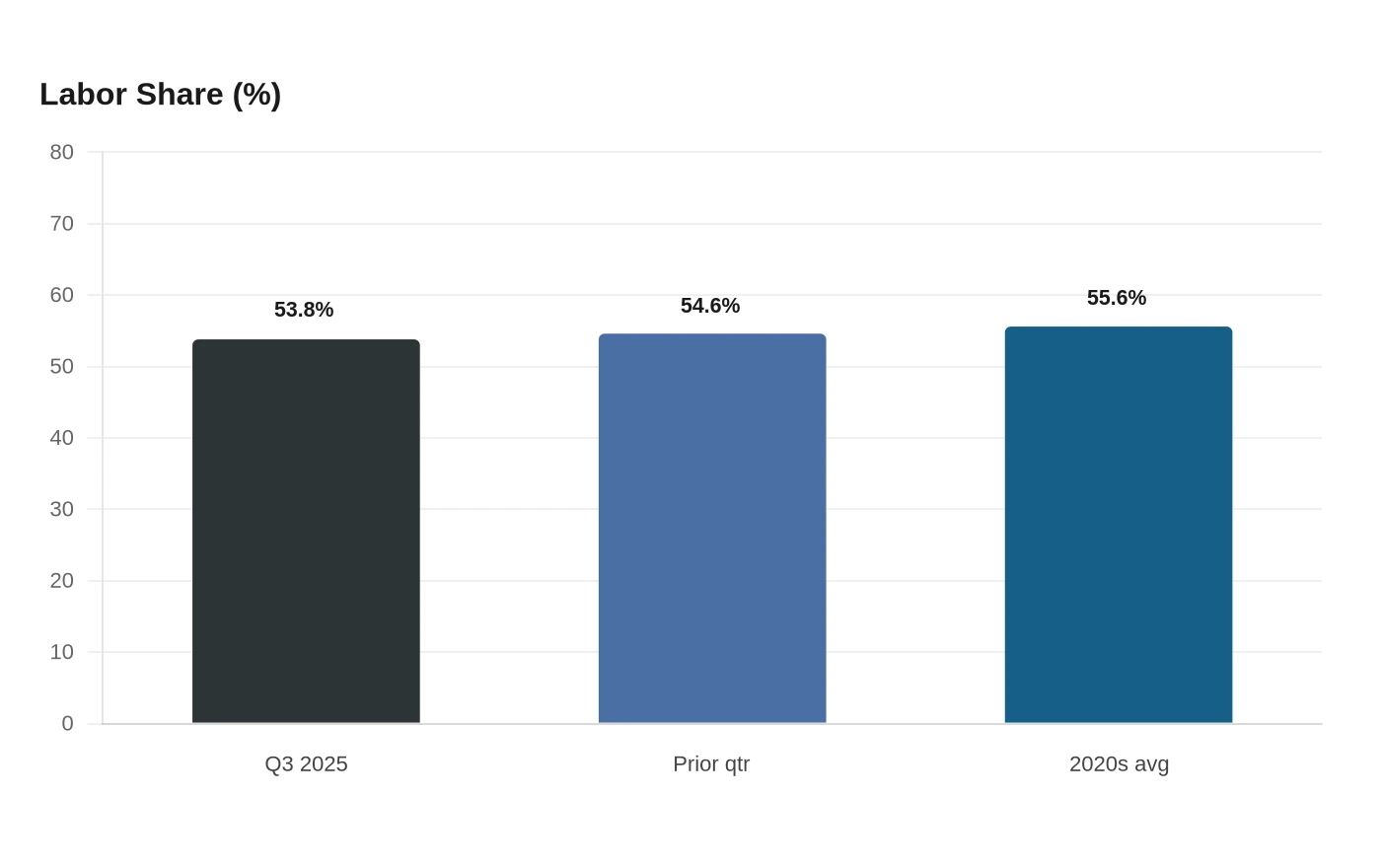
Workers took 53.8% of U.S. economic output in the third quarter of 2025, the smallest labor share in the Bureau of Labor Statistics series that stretches back to 1947. The share was down from 54.6% in the prior quarter and below the 2020s average of 55.6%, leaving a larger slice of national income to profits, dividends and other capital income.
The drop came as productivity surged. The Bureau of Labor Statistics said nonfarm business sector labor productivity rose 4.9% in the third quarter of 2025, with output increasing 5.4% while hours worked edged up only 0.5%. That gap matters because it shows why GDP can grow briskly even when paychecks do not keep pace at the same speed.
A falling labor share does not have a single cause. It can reflect automation, globalization, capital-heavy industries and weaker bargaining power for workers. It also lands in a moment when investment in AI, cloud computing and data centers is pushing more of the economy’s gains toward capital-intensive business models rather than labor-intensive hiring. Yale Budget Lab warned in 2025 that GDP growth had been strong while job growth was barely above zero, averaging 15,000 a month, a stark sign that headline growth has not automatically translated into broad labor-market momentum.
The Congressional Budget Office has also moved its projections lower. In its 2026 outlook, the agency said its estimates of wages and salaries as a share of GDP had been revised downward and that wages had not grown faster than GDP in recent years. That reinforces the argument that the latest reading is not just a one-quarter wobble, but part of a longer drift in how the gains from growth are distributed.
For households, the stakes are straightforward. When productivity rises faster than wages, workers can produce more without capturing a proportionate share of the extra income. That can show up in slower paycheck growth, thinner benefits, and less leverage in wage talks, even as corporate earnings and returns to capital strengthen. It also helps explain why frustration over affordability, housing, healthcare and everyday prices can persist even when GDP looks solid on paper.
Sources
- [1]reuters.com
- [2]x.com
- [3]money.usnews.com
- [4]bls.gov
- [5]cbo.gov
- [6]budgetlab.yale.edu
- [7]brookings.edu
- [8]bea.gov