World
U.S. plans sharp cut in NATO aircraft and warships in Europe
The United States planned a sharp reduction in the aircraft and warships it makes available for NATO operations in Europe, a move that would leave allies with less reach, less surveillance and fewer aerial refueling options in a crisis. The cut hits the hardware that keeps fighters in the air and gives commanders a clearer picture of the battlefield, turning burden-sharing rhetoric into a direct test of NATO’s deterrence posture.
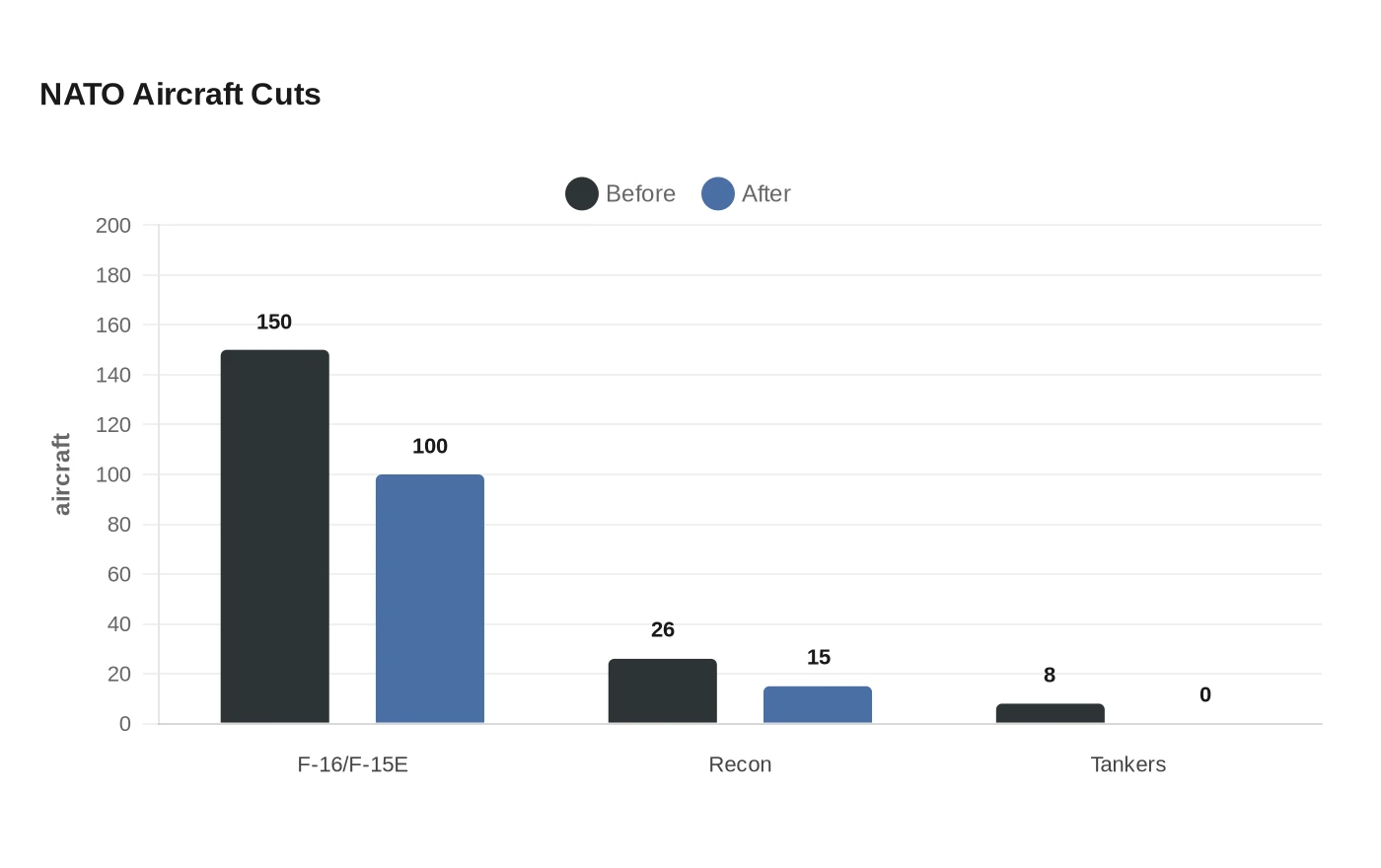
The planned reductions would cut the number of F-16 and F-15E fighter jets available to NATO from about 150 to 100, reduce maritime reconnaissance aircraft from 26 to 15, and remove all eight aerial refueling tanker jets previously available to Europe. Washington also intended to redeploy a missile-launching submarine, an aircraft carrier, several warships and the fighter jets that normally accompany carrier missions, while possibly reassigning one of two bomber groups previously attached to Europe’s defense.
Those changes would matter most in the opening phase of a conflict, when NATO depends on fast access to aircraft, tankers and surveillance platforms to blunt a Russian move and reinforce exposed territory. Fewer tankers would make it harder for allied jets to stay aloft over long distances. Fewer reconnaissance aircraft would reduce the alliance’s ability to track movements at sea and on land. The result would be a thinner crisis pool for the 32-member alliance, especially if Europe had to answer quickly before reinforcements arrived from across the Atlantic.
The U.S. European Command said on June 3, 2026, that officials had notified allies the United States would “rightsize” its NATO Force Model contributions. The command said the change was led by Under Secretary for War for Policy Elbridge Colby and aligned with the 2026 National Defense Strategy, which calls for increased burden-sharing with U.S. allies and partners and lays out a “NATO 3.0” vision. U.S. Air Force Gen. Alexus G. Grynkewich called the current relationship an “unhealthy co-dependence” on U.S. forces, and said Europe should take primary responsibility for its own conventional defense.

That shift pushes the burden onto Europe and Canada, which NATO officials have already signaled must fill gaps with manned and unmanned aircraft and naval vessels. NATO spokesperson Allison Hart said there had historically been an “over-reliance on U.S.” forces and capabilities, and that the balance could shift as Europe and Canada invest more in defense. The alliance’s NATO Force Model, which replaced the NATO Response Force, is designed to organize and activate national forces in peace, crisis or war, and NATO says it has more than tripled the number of high-readiness forces potentially available.
The pressure is not theoretical. NATO’s top military officer is already considering alternate plans for defending Europe if Russia attacks, because the U.S. cutbacks are forcing planners to look beyond the model’s standard playbook. The force model uses a three-tier readiness system, from 0-10 days to 30-180 days, and AP reported it is NATO’s Plan A for the first six months of a conflict. With July’s summit in Ankara approaching, the alliance is being pushed to prove that Europe can carry more of the load without weakening deterrence at the moment it matters most.
Sources
- [1]usnews.com
- [2]eucom.mil
- [3]nato.int
- [4]apnews.com
- [5]media.defense.gov