World
U.S. sanctions global network backing Iran’s Mahan Air

The U.S. Treasury on Thursday sanctioned six people and companies tied to Mahan Air, widening pressure on a network spanning China, India, Russia and Iran that Washington says helps move the airline’s military cargo and personnel. Treasury Secretary Scott Bessent said those providing support were “helping sustain a terrorist enterprise,” casting the carrier as part of Iran’s security apparatus rather than an ordinary commercial airline.
The action targeted actors Treasury said were linked to both Mahan Air and the Islamic Revolutionary Guard Corps, the force at the center of Iran’s regional power projection. Under Treasury’s sanctions system, blocked parties are generally added to the Office of Foreign Assets Control lists, which freezes any property or interests in property under U.S. jurisdiction and bars U.S. persons from most dealings with the designated parties. That reach also creates secondary-risk concerns for banks, brokers and trading firms outside the United States that may still be touching the airline through intermediaries.
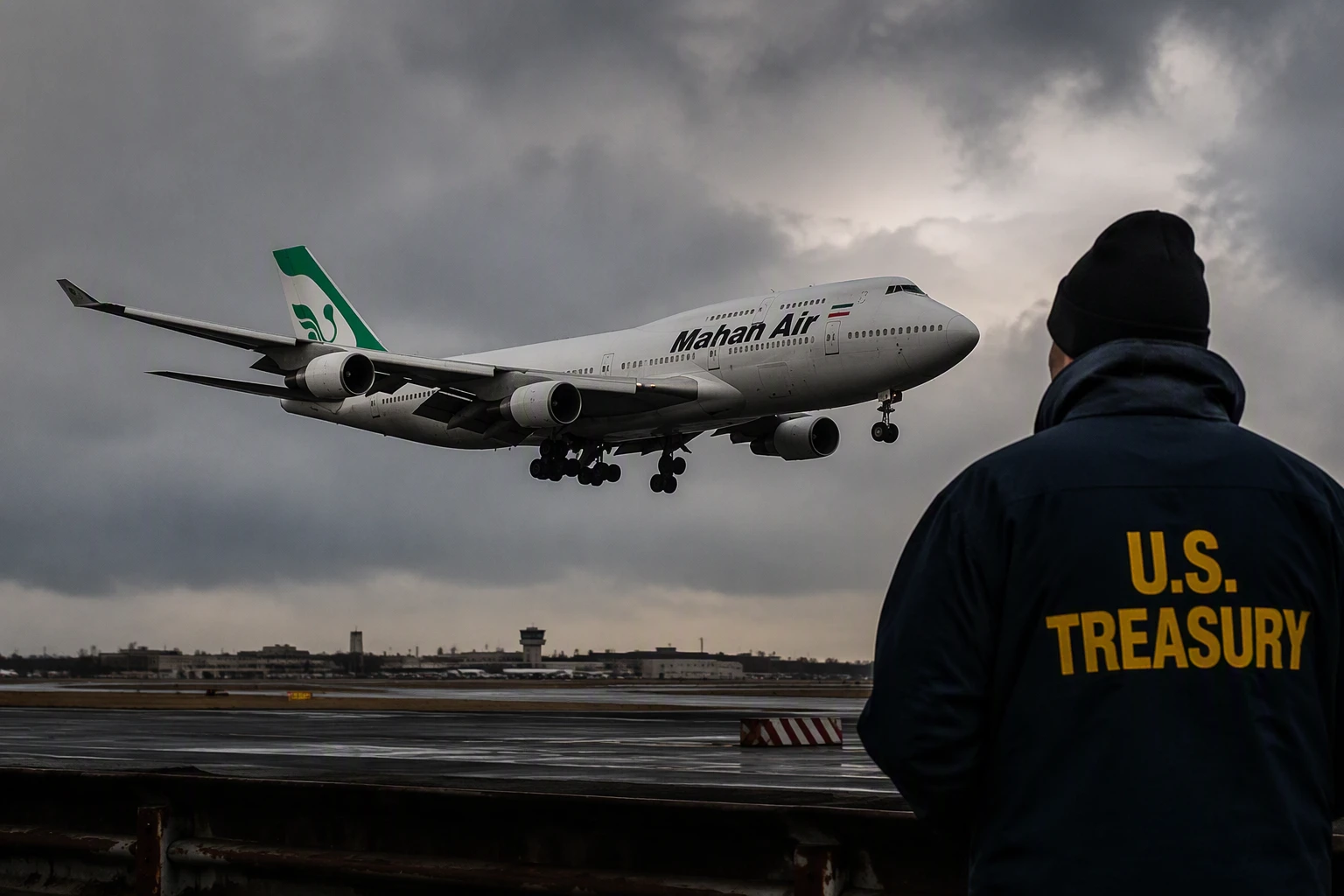
Mahan Air has long been under U.S. and European sanctions, but Washington has repeatedly gone after the support structure around it rather than the airline alone. Previous Treasury actions targeted procurement networks, 31 aircraft associated with Mahan Air and other designated Iranian airlines, service providers and illicit procurement operations. The pattern suggests an effort to squeeze the commercial and logistical channels that keep politically sensitive operations running when direct trade is already restricted.
The latest designations extend that approach beyond Iran’s borders. By naming actors in China, India, Russia and Iran, Treasury signaled that the network sustaining Mahan Air depends on cross-border facilitators, sales agents and logistics handlers who can source parts, arrange transport and move money in ways that are harder to trace than direct state-to-state transactions. That makes the sanctions as much about disrupting access to aircraft, services and procurement as about the airline itself.
The move comes amid the broader U.S. campaign to isolate Iran’s external operations, including the procurement, shadow-fleet, oil-network and drone support systems that Washington has tried to choke off with targeted financial measures. A circulated image of a Mahan Air plane landing at Hodeidah airport in Yemen on July 13 highlighted the regional reach that has shaped U.S. concerns about the carrier’s role in Iranian-linked operations. For now, the new sanctions are likely to add friction for the network that supports Mahan Air, while also serving as another public warning to firms that still do business with Iran’s military-adjacent commercial channels.