Science
US still leads biotech, but China is rapidly closing the gap
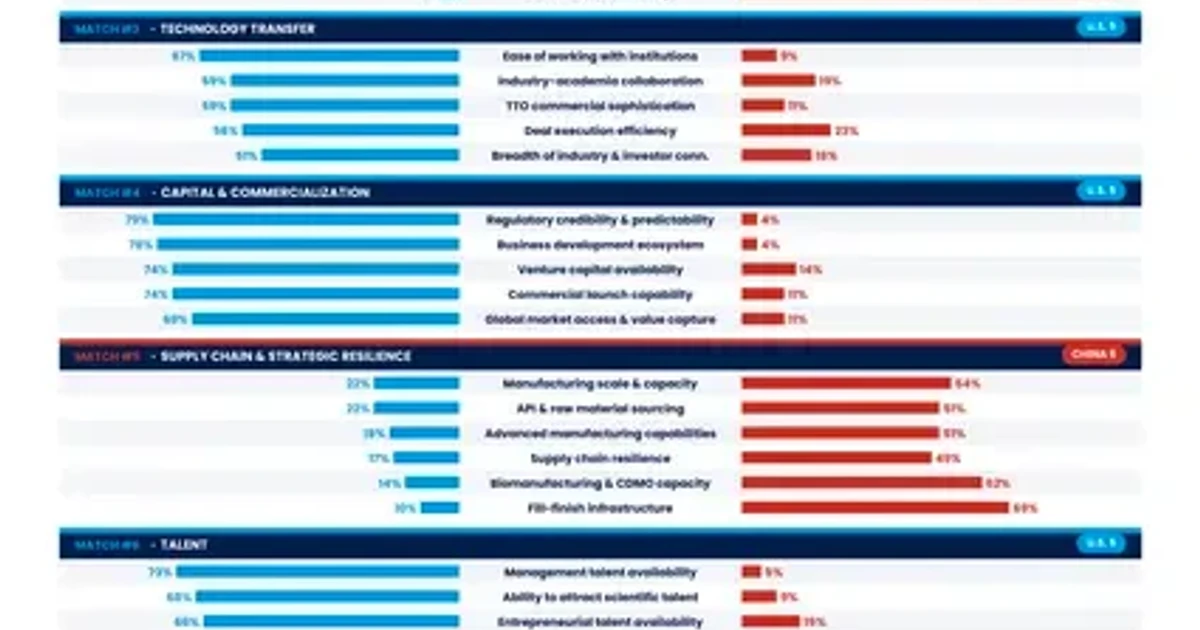
America still leads biotechnology in the places that matter most for turning science into medicine, but senior industry and academic leaders are increasingly wary that the edge will not last. In a Cure Innovation Index survey of 117 U.S. leaders, respondents said China was ahead in clinical development and supply chain strength, while the United States still held the advantage in large-scale production, capital and commercialization, and talent. Scientific discovery was judged to be essentially even, a sign that the contest has shifted from invention to execution.
The warning was sharpened by the survey’s most striking number: 85% of respondents said the U.S. lead in biotech would last 10 years or less. Seema Kumar, chief executive of Cure, said the United States is still leading but that confidence in that lead is weakening, with most respondents viewing China as an existential threat. That sentiment reflects a wider concern in Washington and in the industry that the next phase of competition will be decided not only by who finds promising molecules first, but by who can move them through trials, financing, manufacturing and delivery at scale.
The survey landed in San Diego as biotechnology leaders gathered for the Biotechnology Innovation Organization annual meeting, where the debate over U.S.-China competition was impossible to miss. BIO 2026 ran June 22-25 at the San Diego Convention Center, with BIO expecting about 20,000 attendees and 70,000 partnering meetings. The convention also marked 50 years since the founding of Genentech in California, a milestone often treated as the birth of the modern biotech industry, underscoring how much of the sector’s identity is still tied to U.S. innovation.
But the numbers behind the anxiety point to a real shift. A Georgetown University study found the U.S. share of early-stage drug development programs fell from about 48% in 2015 to just over 37% in 2024, while China’s share rose from 8% to just over 32%. Over the same period, the total number of early-stage programs climbed from 10,417 to 18,999, and Chinese-origin programs surged from 829 to 6,145. That growth helps explain why multinational drugmakers are increasingly licensing molecules from China, drawn by lower costs, streamlined regulation and, critics say, subsidies that distort competition.
The policy response is beginning to catch up. The National Security Commission on Emerging Biotechnology warned in its final report, released April 8, 2025, that China has built a vertically integrated biotechnology ecosystem positioned to challenge U.S. leadership. On June 22, 2026, the U.S. Department of Health and Human Services announced a department-wide effort to restore American leadership in clinical trials and speed development of lifesaving treatments. With the BIOSECURE Act already signed into law on December 18, 2025, Washington is treating biotech less as a niche industrial sector than as a strategic contest over manufacturing capacity, talent flows and patient access.
Sources
- [1]money.usnews.com
- [2]health.georgetown.edu
- [3]convention.bio.org
- [4]bio.news
- [5]hhs.gov
- [6]bakermckenzie.com