Health
Vaping after quitting smoking linked to higher lung cancer risk, study finds
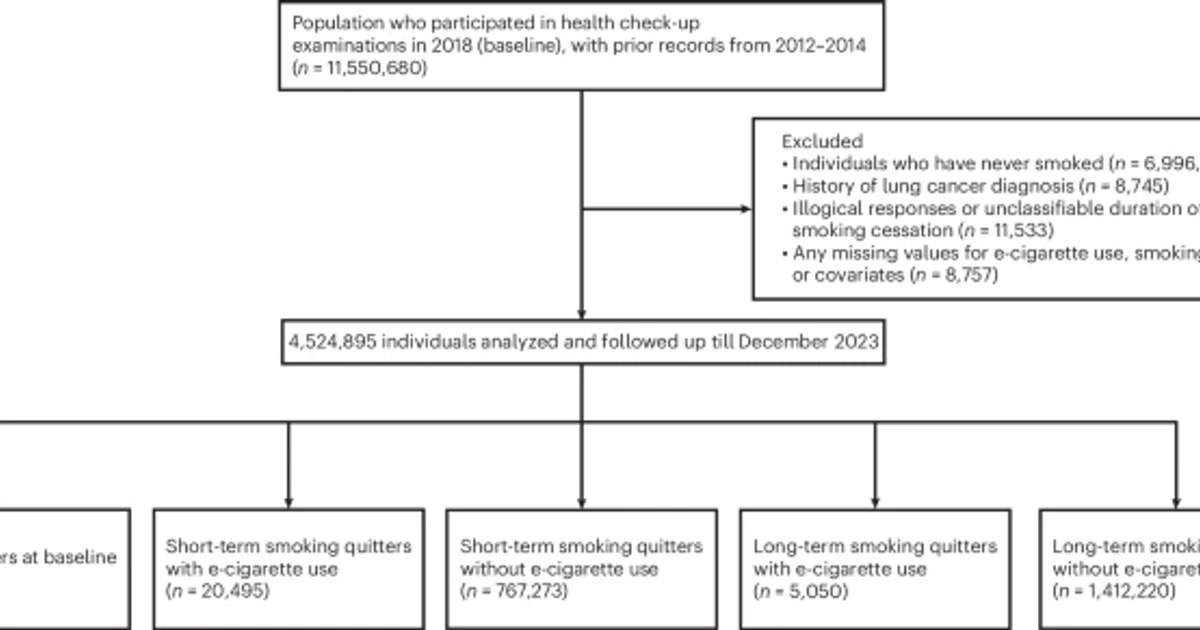
A nationwide analysis of 4.5 million Korean adults found that people who quit smoking but continued to use e-cigarettes faced higher lung cancer incidence and higher lung-cancer mortality than those who quit and stayed nicotine-free. The study does not prove vaping caused those cancers, but it does weaken the comforting idea that switching away from cigarettes automatically delivers the full health payoff of quitting.
The Nature Medicine paper, published online on 8 June 2026, drew on Korean National Health Screening Program data from 2018, with prior records from 2012 to 2014. It followed 4,524,895 adults with a conventional smoking history for more than 24.18 million person-years and recorded 35,887 lung cancers and 12,807 lung-cancer deaths. Researchers separated participants into current smokers, quitters who used e-cigarettes, and quitters who did not use e-cigarettes, then compared outcomes across those groups.
The pattern matters because it suggests post-cessation vaping may blunt some of the gains from giving up combustible tobacco. The study’s abstract is careful on causation: the finding is associative, not causal, and the authors say e-cigarette use after smoking cessation may attenuate the benefits of complete cessation for lung cancer prevention. That leaves important uncertainties about device types, dose, duration, and whether some of the risk reflects the health profile of people who choose to vape after quitting cigarettes.

Even so, the result lands in a broader public-health context that has long pointed in one direction: complete smoking cessation remains the strongest protection. A 2024 Korean cohort study of more than 2 million participants found cancer risk fell gradually after quitting and reached about half the risk of continued smokers after 15 years or more, with lung-cancer risk declining earlier than other cancers. The World Health Organization says lung cancer was the leading cause of cancer death worldwide in 2022, with about 2.5 million cases and 1.8 million deaths, and estimates tobacco smoking causes 60% to 70% of preventable lung-cancer cases. The Centers for Disease Control and Prevention says there are no safe tobacco products, including e-cigarettes, and no e-cigarette has been approved by the FDA as a smoking-cessation aid.
An accompanying commentary from the International Agency for Research on Cancer by Mahdi Sheikh and Pamela M. Ling said the study highlights knowledge gaps that still need to be filled before the long-term health effects of vaping after quitting can be judged confidently. For clinicians and smokers alike, the message is narrower than a ban on harm reduction but sharper than the marketing pitch: vaping may be less harmful than continuing to smoke, yet it is not the same as ending nicotine use altogether.
Sources
- [1]nature.com
- [2]iarc.who.int
- [3]preview-www.nature.com
- [4]cdc.gov
- [5]who.int
- [6]ncbi.nlm.nih.gov
- [7]visualize.jove.com