US News
Virginia seeks Supreme Court review over vanity plate speech rights
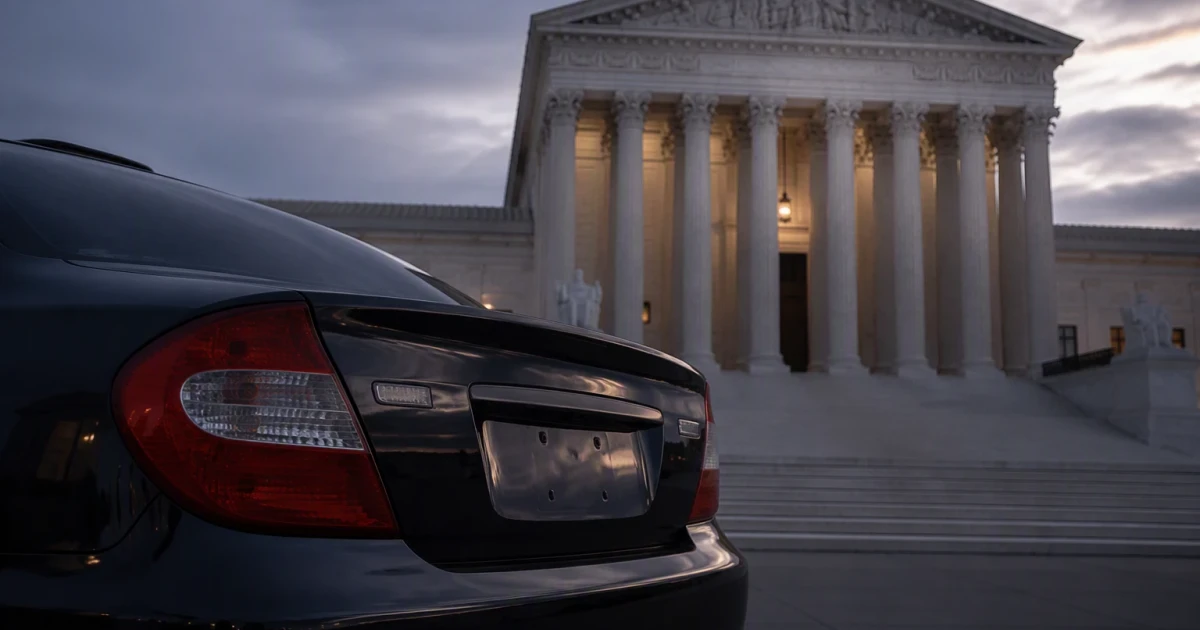
Virginia will ask the Supreme Court to review Whateley v. Lackey, the fight over whether a seven-character vanity plate belongs to the driver or the state. On July 31, a Fourth Circuit panel of Judges Agee and Harris and Senior Judge Keenan vacated and remanded the case in a published opinion written by Judge Harris, saying the personalized character combinations on Virginia plates are private speech, not government speech.
The dispute arises from Virginia Department of Motor Vehicles rules that allow up to seven characters on a personalized plate and let the agency deny an application, then cancel or recall a plate later found to violate its guidelines. Curtis M. Whateley challenged the DMV’s authority to police that message, naming Gerald F. Lackey in his official capacity as commissioner of the Virginia Department of Motor Vehicles. The case had been before Norman K. Moon in the United States District Court for the Western District of Virginia in Lynchburg, under docket 6:25-cv-00010-NKM-CKM.
The ACLU of Virginia joined the Fourth Circuit case as counsel of record for Whateley and said the ruling reaffirmed that personalized license-plate messages are protected by the First Amendment. In its July 31 statement, the group cast the decision as a victory for personal expression in the driver’s seat. The Fourth Circuit ruling was also described in legal coverage as the first time a federal appeals court had held that Virginia’s personalized license-plate messages are private speech.
The stakes reach beyond one Virginia plate. The ACLU of New Hampshire has framed vanity-plate disputes as a threshold question of attribution, whether a plate message should be read as the driver’s expression or the state’s own speech. That question has produced sharp differences across the country. New Hampshire’s highest court struck down a DMV rule used to reject COPSLIE, while Michigan ended enforcement of a vanity-plate restriction after a First Amendment ruling. Indiana later held vanity plates were government speech, and Tennessee reached a similar conclusion in 2025. The Supreme Court’s answer in Virginia could decide how much room states have to reject offensive or controversial messages on state-issued tags and how far that logic extends when agencies police other messages on government-controlled property.
Sources
- [1]nytimes.com
- [2]ca4.uscourts.gov
- [3]acluva.org
- [4]dmv.virginia.gov
- [5]aclu-nh.org
- [6]law.justia.com
- [7]findlaw.com
- [8]courthousenews.com