Science
Voyager 1 Powers Down Instrument to Prolong Historic Mission
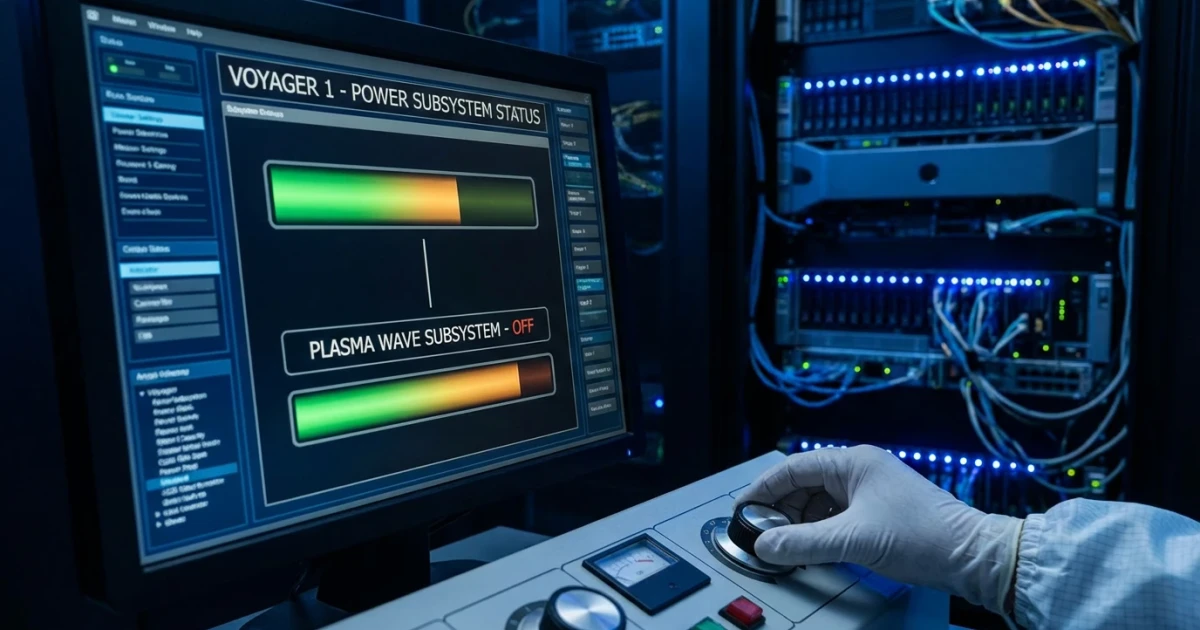
Voyager 1, the farthest human-made object from Earth, has powered down one of its key scientific instruments in a strategic effort by NASA to prolong the spacecraft's groundbreaking mission. The move, reported by CNN and confirmed by NASA Science, is designed to conserve the dwindling power supply and keep the probe transmitting valuable data from the edges of interstellar space.
Why NASA Is Shutting Off Instruments
Launched in 1977, Voyager 1 has vastly exceeded its original mission timeline. Now operating nearly 24 billion kilometers from Earth, the spacecraft is running low on the electrical power generated by its aging radioisotope thermoelectric generators. According to official mission status updates, energy conservation has become critical to keeping core systems and remaining instruments operational.
- Voyager 1's power output drops by about 4 watts per year as its plutonium fuel decays.
- NASA has gradually turned off non-essential systems and heaters since 2019 to stretch the mission's life.
- The latest step involved shutting down the Plasma Wave Subsystem, one of four original science instruments still active.
Balancing Science With Longevity
According to CNN, the decision to power down the Plasma Wave instrument follows a series of technical challenges and signals NASA's commitment to prioritizing the collection of the most critical interstellar data. While the Plasma Wave Subsystem has contributed to major discoveries, including evidence of the spacecraft's passage into interstellar space, NASA determined that keeping other instruments online—such as the Cosmic Ray Subsystem and the Low-Energy Charged Particle instrument—would yield higher-priority data as Voyager 1 ventures farther from the Sun.
NASA Science explained that this conservation effort is part of a larger strategy, sometimes called the 'Big Bang fix,' to ensure the spacecraft continues to operate as long as possible. The agency has not ruled out additional power-saving steps, and the mission team is closely monitoring all systems for signs of degradation.
Voyager 1's Legacy and Ongoing Discoveries
Voyager 1 famously entered interstellar space in 2012, crossing the heliopause and leaving the sphere of the Sun's influence. Since then, it has sent back unique data on cosmic rays, magnetic fields, and the characteristics of the interstellar medium. The spacecraft's discoveries continue to inform scientists about the nature of our solar system's outer boundary and the environment beyond.
- Voyager's instruments have provided unprecedented measurements of high-energy particles and electromagnetic waves in deep space.
- Selected data streams, including those from remaining active instruments, are accessible through NASA's Planetary Data System.
What Comes Next for Voyager 1?
As power reserves continue to decline, NASA expects to gradually shut down additional systems in the coming years. While the mission team hopes to keep Voyager 1 transmitting until at least 2030, each step to conserve energy marks a calculated trade-off between scientific output and the spacecraft’s operational lifespan.
The Voyager 1 team has repeatedly demonstrated ingenuity in troubleshooting and extending the probe’s work, despite immense technical challenges and communication delays that now stretch over 22 hours round-trip. The probe’s continued operation stands as a testament to decades of engineering and scientific collaboration.
Conclusion
Voyager 1’s recent power-down of a scientific instrument highlights both the challenges and the legacy of humanity’s most distant explorer. With every maneuver, NASA weighs the value of new discoveries against the realities of aging hardware and finite power. As Voyager 1 pushes deeper into interstellar space, scientists and the public alike continue to benefit from the mission’s enduring stream of cosmic insights.