Science
Voyager 1's Iconic 'Pale Blue Dot' Turns 36
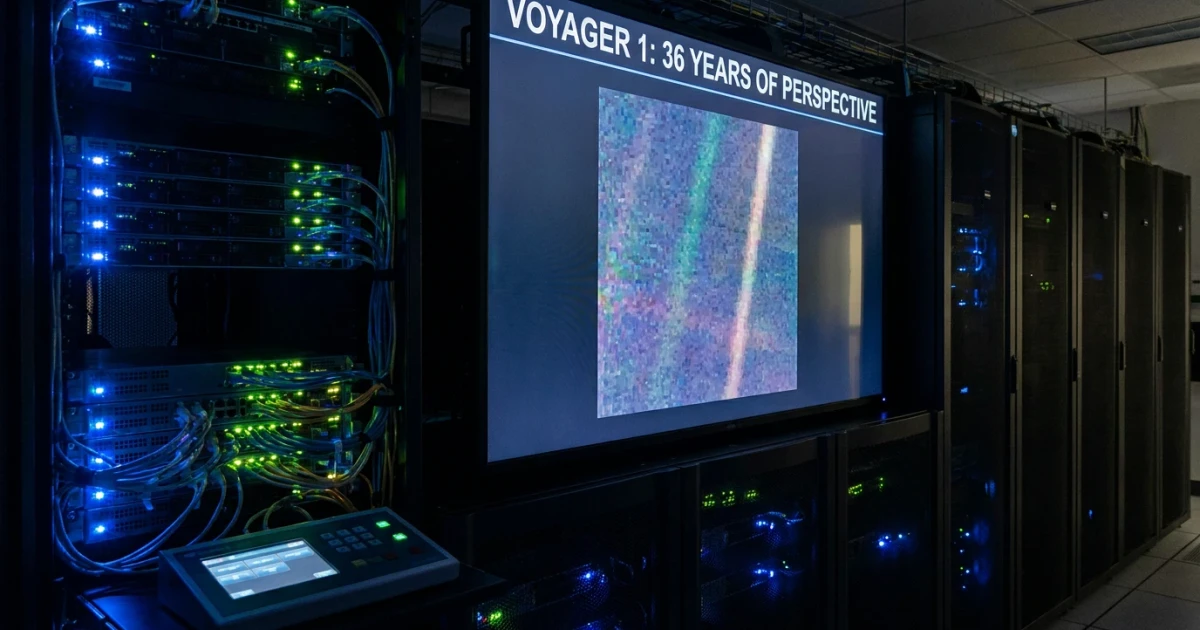
Voyager 1's famous Pale Blue Dot photograph, captured in 1990, continues to resonate as a cosmic milestone and a profound reminder of Earth’s fragile place in the universe. After years of persistent advocacy by renowned astronomer Carl Sagan, NASA's Voyager 1 spacecraft turned its camera back toward home from nearly 6 billion kilometres away, snapping an image that would become one of the most iconic in space exploration history.
How the Pale Blue Dot Came to Be
The decision to capture the Pale Blue Dot image was not straightforward. According to Space Daily, NASA initially resisted the idea due to concerns over the technical risks and limited scientific value. However, Sagan’s relentless lobbying ultimately convinced the agency to command Voyager 1 to turn its camera back toward the inner solar system.
From its vantage point—about 6 billion kilometres from Earth, beyond the orbit of Neptune—the spacecraft snapped a series of images. Among them was Earth, appearing as a tiny speck smaller than a single pixel. The photograph's scale and perspective, with Earth reduced to a minuscule dot amidst the vastness of space, immediately drew attention for its philosophical and scientific significance.
The Image and Its Impact
The Pale Blue Dot image, part of a mosaic of the solar system, was released by NASA and remains at the core of the Voyager mission’s legacy. As detailed by NASA’s official feature, the photo’s resolution is so fine that Earth is barely visible—yet its presence is unmistakable, a lone blue pixel suspended in a sunbeam.
- The photograph was taken on February 14, 1990
- Voyager 1 was approximately 6 billion kilometres from Earth
- Earth’s image occupies less than a pixel in the final mosaic
Sagan’s reflections on the image, recorded in his book and echoed in mission documentation, emphasize the humility it inspires. The photo has been widely cited in scientific literature—including a peer-reviewed study—for its technical achievement and its philosophical implications.
Technical and Scientific Legacy
The Voyager 1 mission, launched in 1977, remains the farthest human-made object from Earth. Its imaging subsystem, which produced the Pale Blue Dot, is archived in the NASA Imaging Science Subsystem (ISS) Data Archive for researchers and the public.
Although the photo itself was not intended for scientific measurement, its technical feat represents a triumph in remote sensing and spacecraft operations. It required precise coordination and calibration, as described in mission records, to capture images across such immense distances.
The Enduring Message
Today, the Pale Blue Dot continues to inspire not just scientists but the broader public. Its legacy is entwined with the ongoing Voyager mission status, reminding us of humanity’s ability to reach the edge of the solar system—and to look back with awe.
As Space Daily succinctly noted, after Sagan’s lobbying, NASA relented and took the photo. The resulting image became a touchstone for cosmic perspective, environmental stewardship, and scientific curiosity. Thirty-six years later, the Pale Blue Dot is a powerful symbol of our place in the vastness of space, urging reflection on both the achievements and responsibilities of humanity.