Science
Voyager Golden Record’s Human Imagery Shaped by Pioneer Plaque Debate
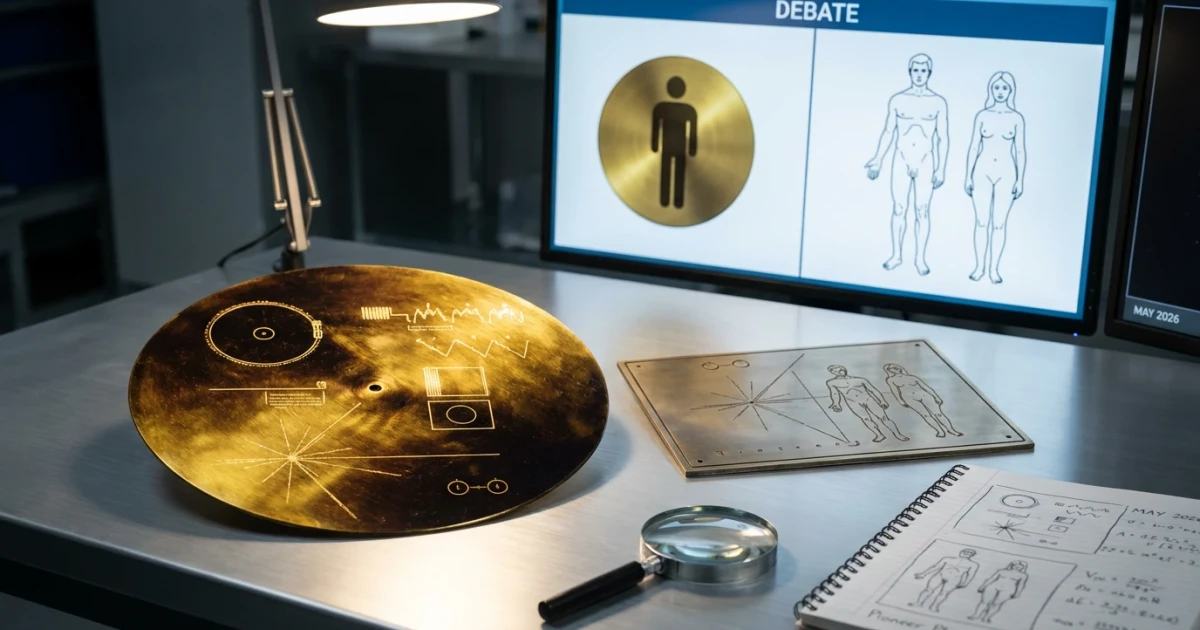
NASA’s Voyager Golden Record, launched aboard the Voyager spacecraft in 1977, sought to communicate the essence of humanity to any extraterrestrial intelligence that might encounter it. While the record is celebrated for its collection of sounds and images from Earth, a lesser-known aspect of its design reveals how scientific ambition collided with societal sensitivities — especially concerning the portrayal of the human body.
The Original Plan: A Bold Depiction of Humanity
As reported by Space Daily, Carl Sagan’s team initially considered sending a nude photograph of a man and a pregnant woman as part of the Record’s imagery. The intent was to provide an honest, scientific representation of human anatomy and reproduction, reflecting a desire to communicate biological information clearly to any potential alien discoverer. This concept followed the precedent set by the Pioneer plaque, which was launched in 1972 and 1973 aboard the Pioneer 10 and 11 probes and featured line drawings of nude human figures.
Controversy Surrounding the Pioneer Plaque
The Pioneer plaque’s depiction of nudity sparked heated public debate in the 1970s. Some praised the scientific openness, while others saw it as inappropriate or embarrassing. Detailed analysis in the Proceedings of the National Academy of Sciences documents how the plaque’s nude imagery generated both headlines and criticism, even prompting jokes and letters to NASA questioning the need to send such images into space. This backlash influenced how subsequent missions would handle the depiction of humans.
- The Pioneer plaque included detailed nude drawings of a man and woman, with anatomical features clearly visible.
- Public reaction ranged from support for scientific transparency to criticism and discomfort, particularly regarding the woman's nudity and the perceived "impropriety" of sending such images beyond Earth.
- The controversy contributed to a more cautious approach in NASA’s later attempts at portraying humanity in interstellar messages.
Voyager Golden Record: A Silhouette Instead
Given the experience with the Pioneer plaque, Sagan’s team reconsidered their initial plan for the Voyager Golden Record. Instead of a nude photograph, they opted for a silhouette of a man and a pregnant woman. This approach preserved the educational intent — conveying human form and the concept of reproduction — while sidestepping the public outcry that nudity had previously provoked.
The final silhouette image, as detailed in the official NASA image archive, provides enough anatomical detail for a scientifically literate audience without explicit nudity. This compromise was widely seen as balancing scientific integrity with cultural sensibilities.
- The Voyager Golden Record contains 116 images, including the human silhouette, as outlined in NASA’s published PDF.
- The decision-making process and the story behind the images are described in detail by The Planetary Society.
Reflecting on Science, Society, and Space Communication
The evolution from nude line drawings on the Pioneer plaque to silhouettes on the Voyager Golden Record highlights the ongoing negotiation between scientific communication and societal values. While the original intent was to represent humanity in a straightforward, biological manner, the need to address public perception ultimately shaped the final message sent beyond our solar system.
As future missions consider how to represent life on Earth, the experience of the Voyager team serves as a case study in balancing openness, accuracy, and cultural context. The Voyager Golden Record remains a testament to both scientific ambition and the complexities of speaking for all humankind.