Science
Webb Telescope Reveals Dazzling Spiral Galaxy Core
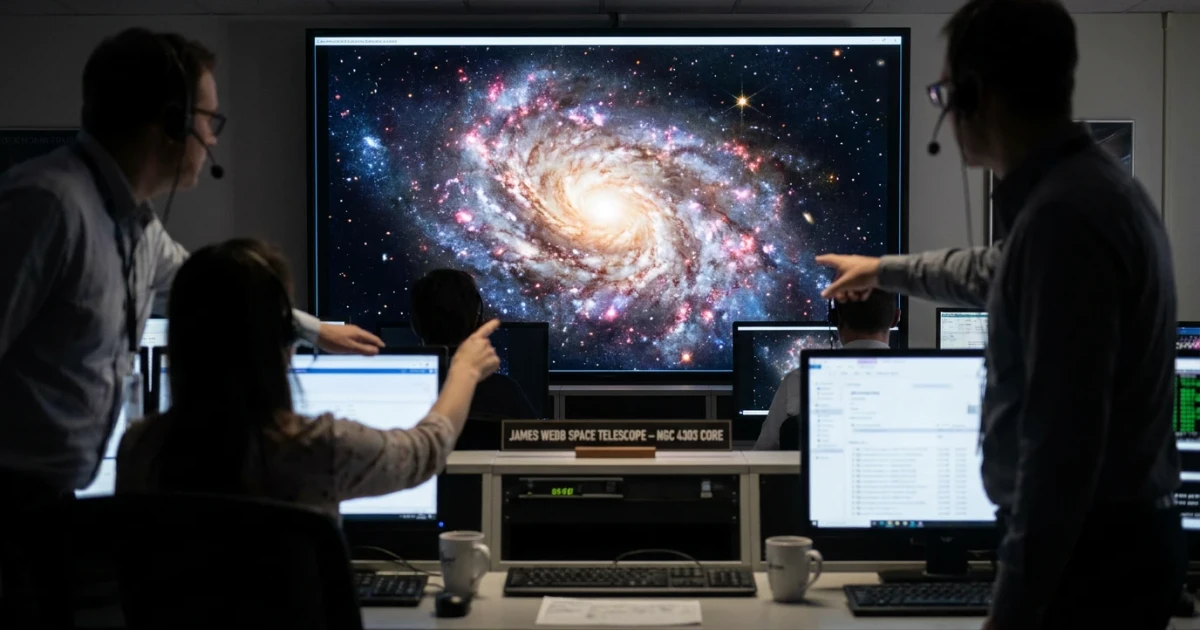
NASA’s James Webb Space Telescope has delivered another landmark astronomical image, this time capturing the brilliant heart of a spiral galaxy in unprecedented detail. The newly released picture showcases the galaxy’s luminous core, highlighting the cutting-edge capabilities of Webb and deepening our understanding of how these cosmic structures evolve and shine.
Webb’s Latest Look at a Galactic Powerhouse
The image, released by NASA and highlighted by ABC News, focuses on the vibrant central region of a spiral galaxy—one of the most visually striking and scientifically significant targets in the universe. Spiral galaxies are known for their sweeping arms and bright centers, which are often hubs of intense star formation and complex dynamics. Webb’s powerful infrared instruments have allowed astronomers to peer through dust and gas, revealing details that were previously hidden from view.
- The galaxy’s core appears exceptionally bright in the Webb image, thanks to the telescope’s ability to capture infrared wavelengths that cut through cosmic dust.
- This new view offers astronomers key insights into the structure of the galaxy’s nucleus, the distribution of newly formed stars, and the interplay of dust and gas at the heart of a spiral.
- Infrared observations like these are vital for studying the regions where stars are born, as these areas are often obscured in visible light.
Why Spiral Galaxies Matter
Spiral galaxies, such as the Milky Way, comprise a large portion of observed galaxies in the universe. Their distinct arms and glowing cores are shaped by gravitational forces acting over billions of years. The recent Webb image adds to an expanding gallery of spiral galaxies observed by the telescope, each observation providing new data for astronomers to analyze.
According to the Webb Science Highlights, such high-resolution images help researchers:
- Trace the flow of gas and dust feeding star formation
- Identify sites of recent supernova explosions
- Map the distribution of massive stars and black holes in galactic centers
These insights are essential for understanding not only how spiral galaxies work, but also how galaxies evolve over cosmic time.
Webb’s Edge in Infrared Astronomy
The James Webb Space Telescope was designed to push the boundaries of astronomical imaging, especially in the infrared spectrum. Unlike its predecessor Hubble, which observes mainly in visible and ultraviolet light, Webb’s instruments can see through the dust that often obscures the most interesting parts of galaxies.
- The telescope’s image gallery is already filled with detailed views of spiral galaxies, nebulae, and early-universe objects.
- By analyzing the colors and brightness in these images, scientists can estimate the ages of stars and the composition of interstellar material.
This latest image further demonstrates Webb’s crucial role in advancing our knowledge of the universe’s most complex and beautiful structures.
Expanding the Frontiers of Galactic Research
While ABC News emphasized the visual splendor of the recent spiral galaxy image, astronomers are already drawing on this data to inform ongoing research. The Webb Space Telescope Science Archive makes raw and processed data from these observations available to scientists worldwide, accelerating discoveries and collaboration.
As more spiral galaxies come into focus through Webb’s advanced optics, researchers expect to unlock new secrets about the life cycles of galaxies, the forces shaping their evolution, and the origins of the stars within them. For readers interested in the science of galaxy formation and structure, the ESA/Hubble Science explainer offers in-depth background on these cosmic marvels.
Looking Ahead
Webb’s ongoing mission promises many more revelations. Each image adds a piece to the puzzle of how galaxies—and the universe itself—came to be. The telescope’s ability to capture the hidden heart of a spiral galaxy is more than just visually stunning; it’s a leap forward for astronomy and our quest to understand the cosmos.