Science
Webb Telescope's 'Red Dots' Puzzle Astronomers
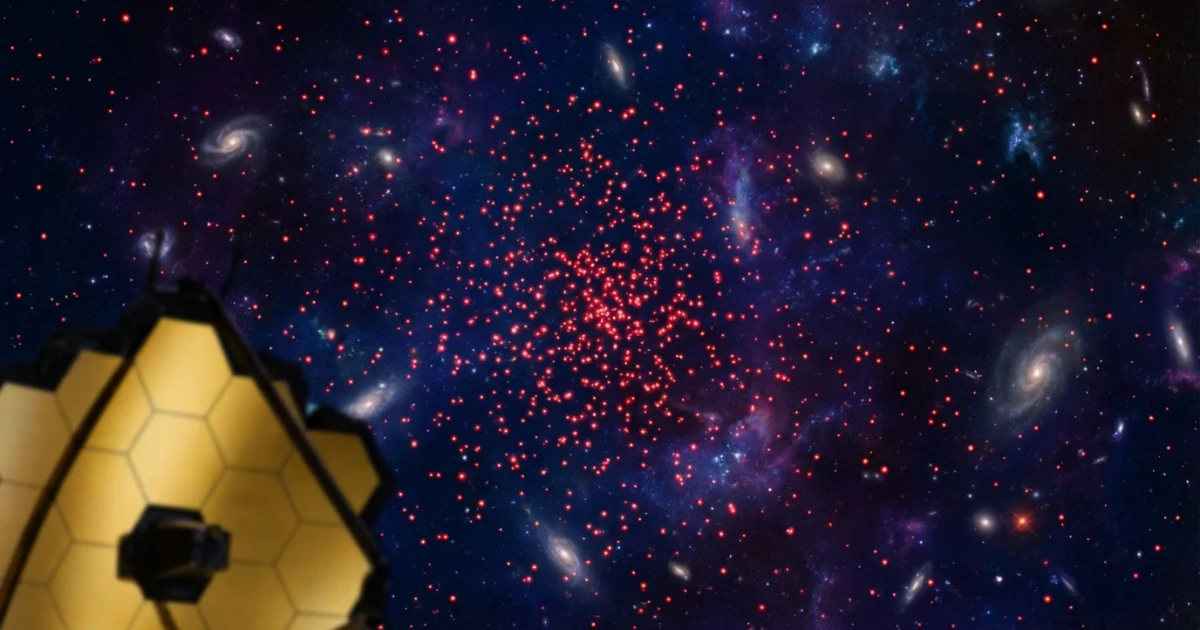
Images captured by the James Webb Space Telescope (JWST) have revealed mysterious little red dots scattered across the depths of the universe, sparking curiosity and debate among astronomers worldwide. While these objects have been detected in several deep field images, their true nature remains uncertain, highlighting the ongoing surprises delivered by the JWST’s unprecedented capabilities.
Unexpected Discoveries in Deep Space
The recent JWST data, as first reported by CNN, shows a notable population of compact, intensely red objects in the distant universe. These dots, appearing prominently in the telescope’s infrared surveys, have not been definitively classified. The colors and brightness of these dots suggest they might be candidate massive galaxies formed just 600 million years after the Big Bang, but alternative explanations remain on the table.
Astronomers analyzing the JWST data archive have identified these dots in several fields targeted by JWST’s Cycle 1 General Observer programs and Early Release Science surveys. These programs were designed to push the limits of our observations into the cosmic dawn, seeking out the very first galaxies to form in the universe.
What Makes the Red Dots So Mysterious?
Unlike well-studied galaxies or bright stars, these red dots are both extremely faint and remarkably compact. Their intense red color comes from their emission at infrared wavelengths, which JWST is uniquely equipped to detect. This color can indicate extreme distances—meaning the objects could be among the universe's earliest structures—or could arise from other astrophysical processes, such as dust obscuration or exotic star formation mechanisms.
Some astronomers, referencing data from the CEERS survey, have speculated that these objects might be massive galaxies that formed surprisingly early in cosmic history, challenging existing models of galaxy formation. Others are more cautious, noting that without spectroscopic confirmation, some of the red dots might be closer objects with unusual properties or even artifacts from data processing.
How JWST’s Data Is Changing Our View
The Webb telescope’s powerful data products allow astronomers to peer further and with more detail than ever before. The red dots were largely invisible to previous telescopes, including Hubble, due to their faintness and extreme infrared color. JWST’s instruments, especially NIRCam and MIRI, are designed to pick up these ancient signals, revealing objects that push the boundaries of current astrophysical understanding.
NASA’s own public features have highlighted the telescope’s ability to unveil previously hidden details in well-known objects, but the red dots represent a different kind of enigma—entirely new targets whose nature and significance are still being explored.
What Comes Next?
- Further spectroscopic observations with JWST are planned to determine the distances and properties of these red dots.
- Ongoing analysis of public JWST data releases is expected to expand the catalog of mysterious objects.
- Peer-reviewed research, such as the study in Nature describing a population of red candidate massive galaxies, is being closely scrutinized for clues to the dots’ origins.
As astronomers continue to investigate, these little red dots underscore the transformative power of the JWST in reshaping our understanding of the cosmos. Whether they turn out to be early massive galaxies, rare astrophysical phenomena, or something entirely unexpected, the search for answers is likely to yield new insights into how the universe’s first structures formed and evolved.
For those eager to track the latest developments, the JWST Early Release Science program records and public data archives offer a window into this unfolding scientific detective story. As new data and analyses arrive, the astronomical community and the public alike await answers to one of the most intriguing mysteries revealed by the Webb telescope so far.