Sports
What happened to David Batty after England’s 1998 penalty miss?
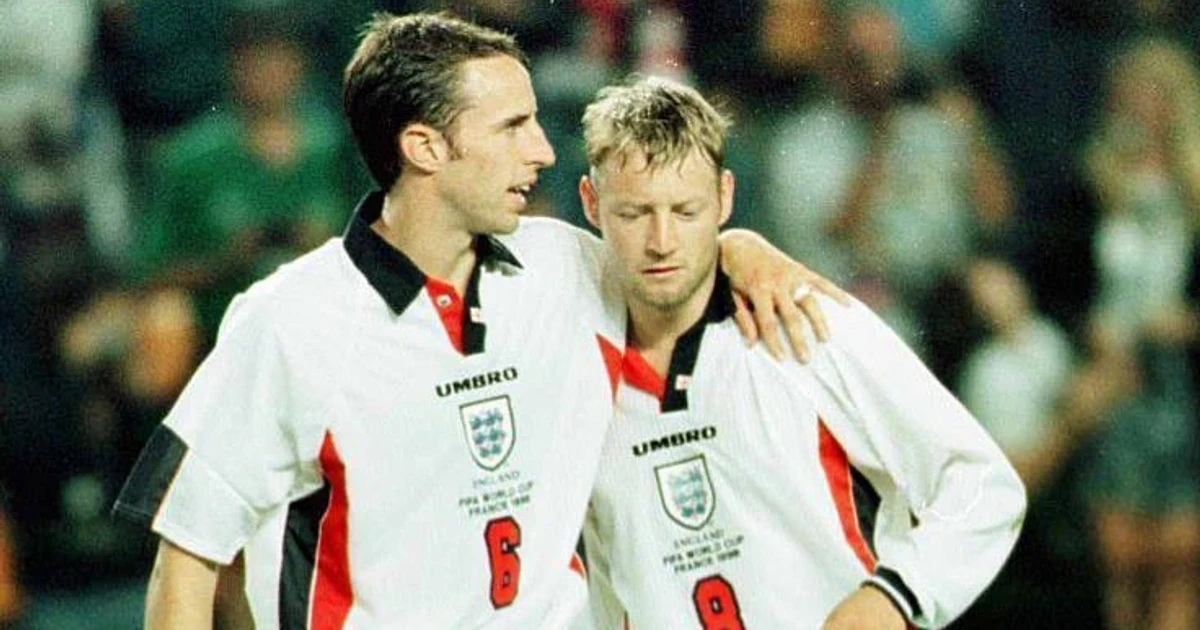
David Batty walked to the spot in Saint-Étienne carrying more than one penalty. England had already been through 120 minutes of tension, Michael Owen’s goal, and David Beckham’s red card when Batty, a substitute, took the decisive fifth kick in the shootout and missed. The moment became one of the most replayed scenes from England’s 1998 World Cup, but it was only one chapter in a career that kept moving back toward Leeds United.
The shootout that defined a rivalry
The match was played on 30 June 1998 at Stade Geoffroy-Guichard in Saint-Étienne and finished 2-2 after extra time. Argentina won the penalty shootout 4-3, and FIFA identifies Batty’s miss as the decisive England kick. Both teams had converted three of their first four penalties before Roberto Ayala scored Argentina’s fifth, leaving Batty to face Carlos Roa with the game on his boots.
That pressure sat inside a wider rivalry with history behind it. England and Argentina were meeting in a World Cup knockout tie that carried more baggage than a normal round-of-16 match, and the 1998 edition had already become a tournament of big moments. Owen’s strike gave England one of its great World Cup goals, Beckham’s dismissal turned the mood sour, and the shootout sealed the sense that this was a game too heavy for just one narrative.

Batty later said it was the first penalty he had ever taken. That detail matters because it reframes the miss as a brutal footballing demand placed on a player known more for control, industry and discipline than for spot-kick theatrics. In an era when midfielders were expected to do the hard work and leave the drama to others, Batty was the man asked to finish a match that had already run past 120 minutes.
What came after the miss
The penalty did not send Batty into exile. He returned to Leeds United in 1998 and stayed until 2004, ending his playing days there after six more seasons at Elland Road. Across his two spells with Leeds, he made 373 appearances and scored four goals, a record that shows how central he remained to the club long after Saint-Étienne.
His wider club career was equally substantial. Batty made 438 league appearances in total, evidence of a long, durable career rather than a life defined by a single bad moment. That kind of longevity matters when looking back at a miss that has often been reduced to a freeze-frame, because the rest of his record points to a player who kept doing the job at a high level.
Batty’s international career was also firmly established before that summer. He won 42 England caps between 1991 and 1999, and he represented his country at Euro 1992 as well as the 1998 World Cup in France. The numbers place the penalty in the proper context: it was the ending of a long England career, not the introduction to one.
The view from 1998, and the view now
The 1998 World Cup was held in France from 10 June to 12 July and featured 32 teams and 64 matches, the largest finals tournament FIFA had staged at the time. In that setting, a round-of-16 penalty miss could become a national event for days or weeks, but the cycle of criticism still moved more slowly than it does now. The blowback arrived through television, newspapers and the same highlights being replayed again and again, rather than through a permanent social feed that follows a player everywhere.
That difference changes the meaning of redemption. In 1998, a player could absorb the blame, return to club football and let time do part of the work. Today, the miss would be clipped into endless loops, judged in real time, and turned into a permanent digital identity long before the next match. Batty’s era allowed for a more linear recovery: take the hit, keep playing, and let the body of work become larger than the mistake.
His later connection to football also shows how firmly he remained inside the game’s orbit. He was listed by Harrogate Town AFC as vice-president, a sign that he stayed closely tied to Leeds football circles and the wider local network around the club game. That matters because it places him not as a fallen figure outside the sport, but as someone who continued to belong to it in practical, local ways.
Batty’s missed penalty will always sit among the defining images of England’s rivalry with Argentina, yet the fuller story is steadier than the headline moment. He went back to Leeds, finished his playing days there, built a career measured in hundreds of appearances, and stayed close to the football world that shaped him. The miss was national, but the rest of his life remained his own.
Sources
- [1]bbc.co.uk
- [2]fifa.com
- [3]inside.fifa.com
- [4]leedsunited.com
- [5]premierleague.com
- [6]harrogatetownafc.com