US News
When to repair or replace your AC, according to DOE and Angi
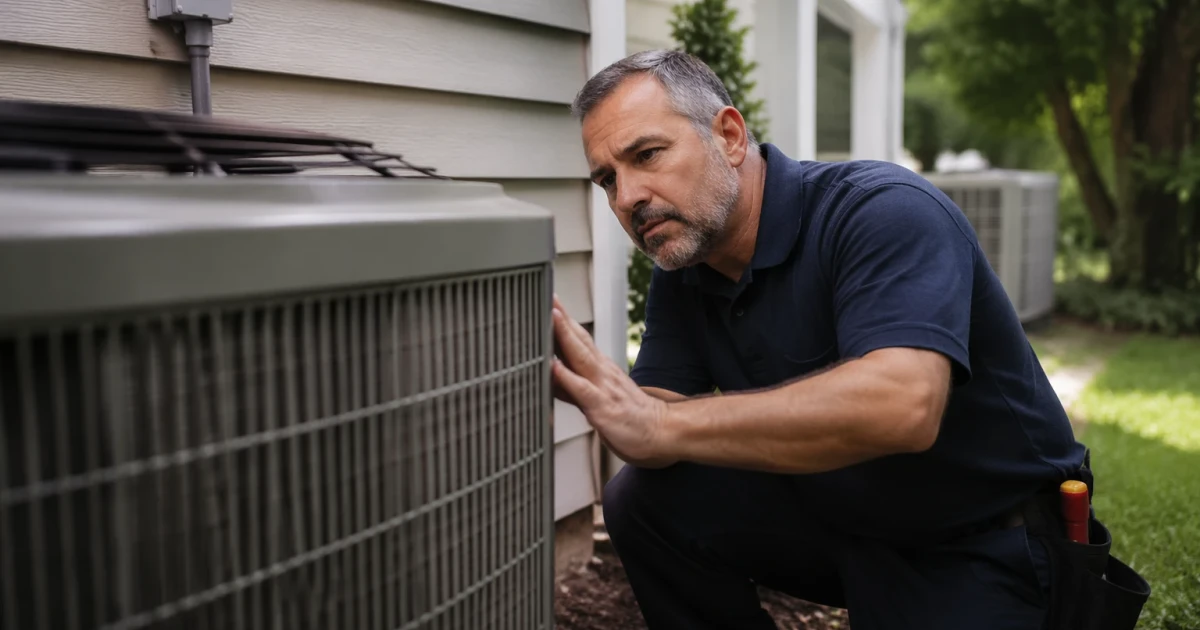
Repairing an air conditioner can be the cheapest answer in a heat wave, but only up to a point. The U.S. Department of Energy says air conditioners account for about 12% of U.S. household electricity use and roughly $29 billion a year in homeowner costs, so every extra month of poor performance shows up on the bill. That makes the repair-or-replace call less of a comfort question than a budgeting decision, especially when a system is older, inefficient, or starting to fail repeatedly.
Start with the age of the unit
Age is the first number that should change the conversation. Angi says central air systems often last about 12 to 17 years, while its broader HVAC guidance puts average lifespan anywhere from 10 to 30 years, with many systems reaching around 20 years when they are maintained properly. If your unit is already in that 12-to-17-year band and needs a serious repair, you are no longer deciding whether to keep a young system alive, you are deciding whether to spend more money on equipment that is already well into its later years.
That aging curve matters because parts wear out unevenly. A compressor, coil, or refrigerant-related failure on a newer system can still be worth fixing, but the same problem on an older one raises the odds that another expensive repair is close behind. In practical terms, the older the system, the more every repair needs to be judged against the likelihood of another service call next summer.
Use the repair bill as a hard cutoff
Cost is the second filter, and Angi gives two useful benchmarks. It says major repairs on older units can exceed $5,000, and replacement often makes more sense when repair costs climb above one-third of the system’s value. That one-third rule is the clearest line in the sand: once a repair quote starts to eat a large slice of the value of the equipment, the money is no longer buying durable reliability, it is buying time.
The logic is straightforward in a hot-weather budget. If a repair is small and the unit is still young, you preserve cash and keep the system running. If the quote is in the thousands and the unit is already old enough to be near the end of its expected life, replacement can be the cheaper long-term choice even if the upfront bill stings more.
Watch efficiency losses, not just breakdowns
A system does not have to stop working to become expensive. DOE says regular maintenance of filters, coils, fins, and refrigerant lines is essential for efficient and effective performance, and neglected maintenance leads to declining performance and higher energy use. That is the hidden cost of waiting too long: the AC may still cool, but it can do so at a steadily higher price.
The same DOE guidance also says switching to high-efficiency air conditioners and taking other cooling steps can reduce energy use for air conditioning by up to 50%. That is why a unit that still runs but struggles to keep up, cycles constantly, or drives monthly bills higher deserves the same scrutiny as a unit that has already failed. Efficiency loss is not a cosmetic issue in a cooling season, it is an ongoing charge against your budget.
Refrigerant type can tilt the math toward replacement
Refrigerant is another threshold that often gets overlooked. Angi says replacement makes sense when a unit uses outdated R-22 refrigerant, which is more expensive and less environmentally friendly than modern alternatives. If an older system still depends on R-22, the repair decision becomes more complicated because the underlying technology is already dated, and future service can be harder to justify.
That is especially important if the problem is refrigerant-related rather than a simple fix like a dirty filter or a loose electrical connection. Once a system needs repeated refrigerant work, the cost of keeping an aging setup alive can rise quickly, and the case for replacing it with newer equipment gets stronger.
Know what kind of replacement you are actually comparing
Central air conditioners come in two main forms: split-system units and packaged units. DOE also notes that if a home already has a furnace and still needs cooling, a heat pump may be worth considering because it provides both air conditioning and heating. That matters for replacement decisions because the best swap is not always another straight AC install, especially when one system can cover two jobs.
Heat pumps also carry a policy advantage. DOE says tax credits and rebates may be available for air-source and geothermal heat pumps, and its home-upgrades guidance says these incentives can come through federal tax credits or state, territory, and tribal rebates. In other words, a replacement can sometimes be cushioned by public incentives, while an old system that keeps limping along gets no such help.
The policy backdrop is pushing toward newer equipment
The replacement math is also changing because federal standards keep tightening. DOE says manufacturers have been required to comply with energy conservation standards for residential room air conditioners since 1990, and it finalized amended room air conditioner standards in 2023 with new requirements taking effect in 2026. Even though that rule is aimed at room units, it reflects the broader direction of policy: newer cooling equipment is being pushed to use less energy and deliver more value over time.
That policy shift matters for homeowners weighing an older system against a new one. When efficient equipment may qualify for credits or rebates and old equipment is becoming costlier to run, the financial case for replacement strengthens, especially if the existing unit is already near the end of its expected lifespan.
Where the math usually flips
The decision is clearest when you stack the numbers together:
• Under roughly 10 years old, with a modest repair and no efficiency problems, repair is usually the safer bet.
• Around 12 to 17 years old, especially with a major repair, replacement deserves a serious look.
• If the repair bill is above one-third of the system’s value, replacement usually makes more financial sense.
• If the unit uses outdated R-22 refrigerant, replacement moves higher on the list.
• If maintenance has slipped and the system is using more power to do less cooling, the hidden operating cost can make a new high-efficiency unit the better long-term buy.
The smartest AC decision is the one that avoids paying twice, first for a patch, then again for the replacement that arrives too soon after. In the heat of summer, the right answer is the option that best balances immediate comfort, future energy bills, and the real remaining life of the system.
Sources
- [1]cbsnews.com
- [2]energy.gov
- [3]angi.com