Technology
Workers weigh AI’s promise and peril for their careers

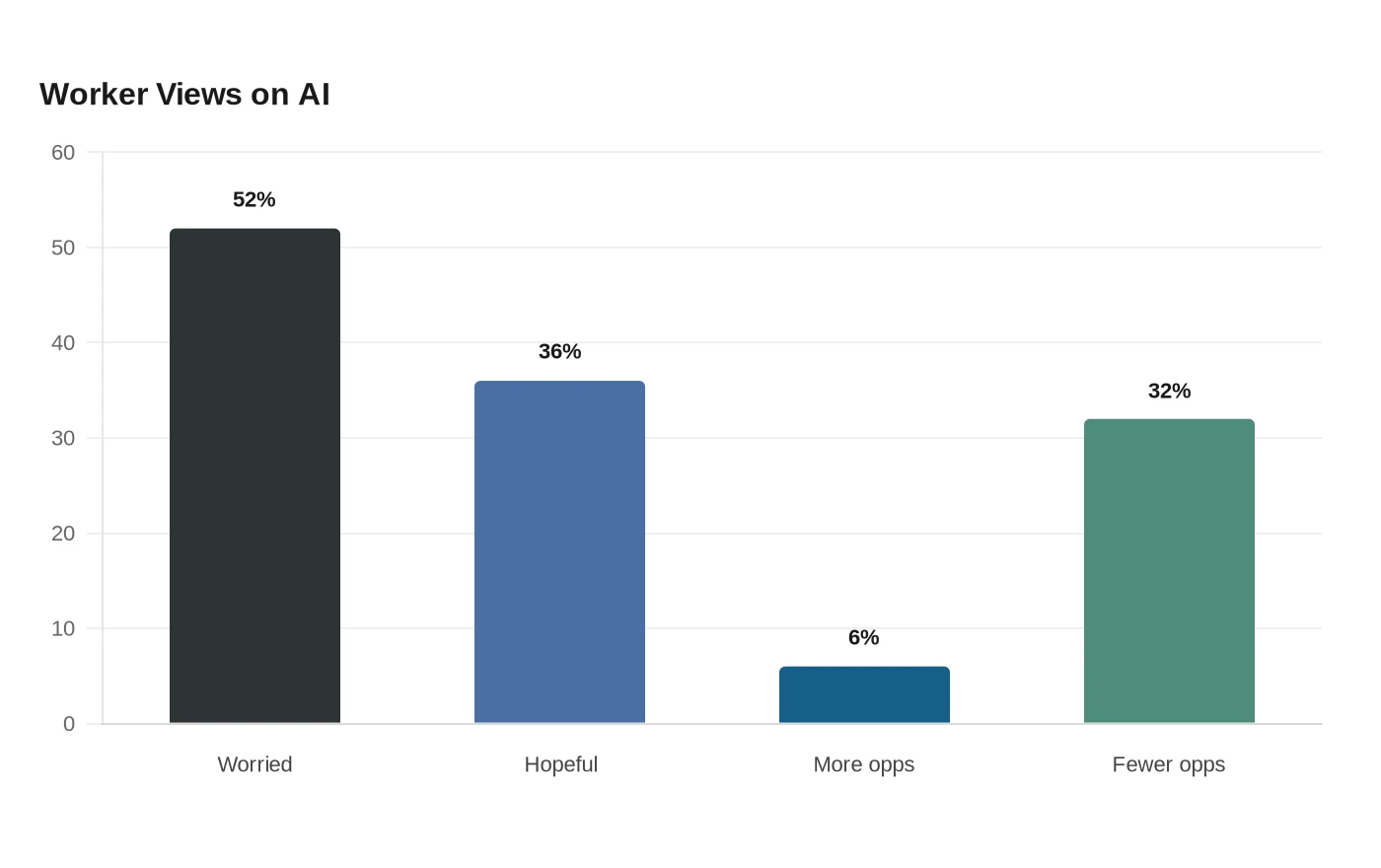
Artificial intelligence is reshaping work less through headline-grabbing layoffs than through a slower, more personal strain on careers. In a Pew Research Center survey, 52% of U.S. workers said they felt worried about how AI may be used in the workplace, while only 36% said they felt hopeful. Just 6% said workplace AI would lead to more opportunities for them in the long run, compared with 32% who expected fewer opportunities.
That unease is showing up in how workers describe their employers. Jobs for the Future said in March that workers were more likely to view AI as a net-negative than a net-positive for finding jobs, building wealth and securing quality of life. The group also found that only about one-third of workers said employers were providing the training, guidance or opportunities they need to use AI at work, and 56% said their employers had not consulted them about how AI tools are being used in their jobs.
The broader labor market, for now, has not yet shown a clear shock from ChatGPT’s release in November 2022. The Budget Lab at Yale said in October that it had not seen a discernible disruption across the U.S. labor market, while noting that major technological change often plays out over decades rather than months or years. That gap between immediate anxiety and slower macroeconomic change is part of what makes the current moment so unsettled for workers trying to judge whether AI will help their careers or hollow them out.
Researchers are also drawing a distinction between tasks and jobs. Stanford Institute for Human-Centered AI and the Stanford Digital Economy Lab surveyed 1,500 workers across 104 occupations and interviewed 52 AI experts. Their July analysis found that 45% of workers doubted AI’s accuracy and reliability, while 23% feared job loss. Workers, the researchers said, generally want AI to handle repetitive tasks, but not to replace human oversight.
MIT Sloan School of Management reached a similar conclusion in October, finding that AI often changes specific tasks within jobs rather than erasing entire occupations. But the school also found a sharper effect when AI can do most of the tasks in a role: the share of people in that job within a company falls by about 14%. For workers, that means the pressure is already real, even before a formal layoff appears. The question now is not whether AI will touch their careers, but how much say they will have in the terms of that change.
Sources
- [1]nytimes.com
- [2]pewresearch.org
- [3]jff.org
- [4]budgetlab.yale.edu
- [5]hai.stanford.edu
- [6]mitsloan.mit.edu