Business
USA Rare Earth commissions Colorado facility to produce oxides outside Asia
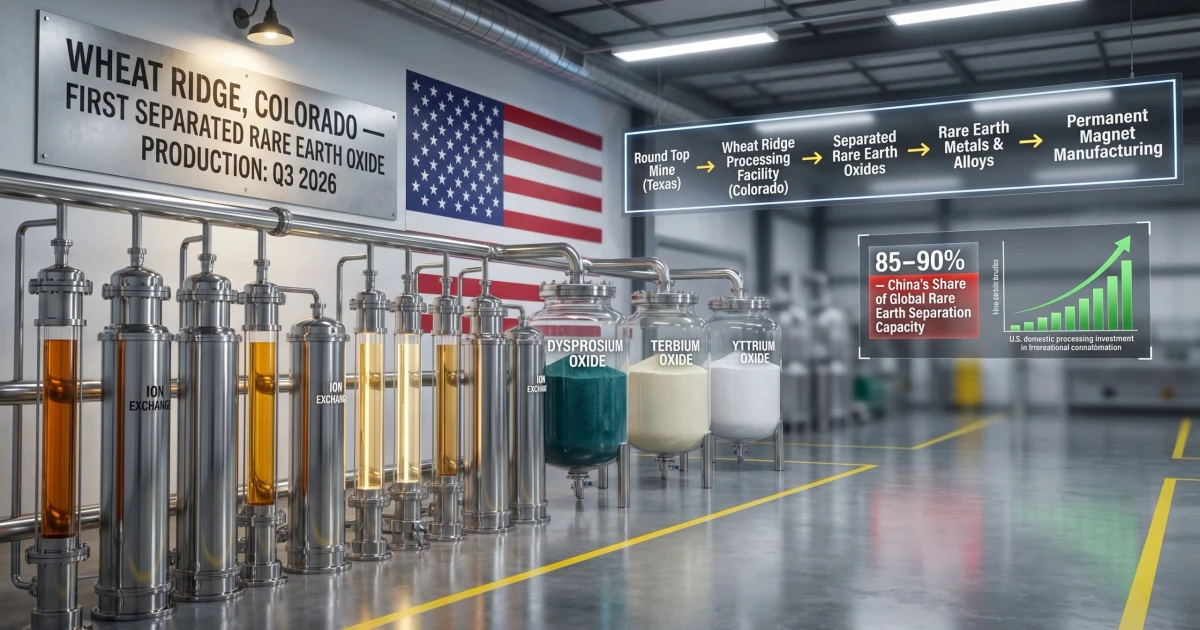
USA Rare Earth has commissioned a hydrometallurgical demonstration facility in Wheat Ridge, Colorado, to make rare-earth oxides outside Asia, with first production of separated heavy rare-earth oxides targeted for the third quarter of 2026. The plant is designed to produce dysprosium, terbium and yttrium oxides, three materials that sit near the most difficult and valuable end of the rare-earth supply chain.
The move lands in a market that has been squeezed by policy as much as geology. China tightened export controls in April 2025 on seven rare-earth elements and magnets used in defense, energy and automotive supply chains, and it still controls roughly 85% to 90% of global rare-earth refining capacity and about 90% of high-strength rare-earth magnet production. That makes processing and separation the real bottleneck, not mining alone, because ore has to be turned into oxides, and oxides into finished magnets, before U.S. manufacturers can reduce their dependence on Chinese supply.
The U.S. Geological Survey classifies rare earths as scandium, yttrium and the lanthanides, and tracks production and demand around the world because the sector is so concentrated. USA Rare Earth’s Colorado plant is meant to push into the narrow midstream layer that has long been dominated by China, where the hardest step is not pulling material out of the ground but refining it into high-purity separated oxides.
The industrial race has already spilled into the courts. On May 22, 2026, MP Materials filed a Texas lawsuit against USA Rare Earth, former MP employee Kevin Elkins and FOM Technologies, alleging misappropriation of magnet trade secrets tied to grain-boundary diffusion technology. USA Rare Earth said the claims were without merit. In June 2026, China added MP Materials and USA Rare Earth to its export-control list, intensifying the squeeze on two of the most visible U.S. rare-earth contenders.
Money is now following the strategic urgency. One report linked USA Rare Earth to a $1.6 billion CHIPS Act package, including $277 million in grants and $1.3 billion in loan capacity, while another said federal and state commitments to USA Rare Earth and MP Materials now exceed $2 billion combined. Texas also added a $14.2 million Semiconductor Innovation Fund grant for the Round Top project, a reminder that the rare-earth fight now reaches from mines and processing plants to magnets, defense systems and chip-adjacent industrial policy.
Pressure has also widened beyond the United States. Reuters reported that China’s exports of some rare earths used for magnets to Japan were negligible in May, underscoring how fast supply constraints can ripple through allied manufacturing chains. For USA Rare Earth, the Colorado facility is a start, but the harder test is whether the United States can build the rest of the chain fast enough to keep the material from leaving the Pacific.
Sources
- [1]news.google.com
- [2]investors.usare.com
- [3]msn.com
- [4]csis.org
- [5]usgs.gov
- [6]data.usgs.gov
- [7]nytimes.com
- [8]thesheffieldpress.com